
Dr. Homi J. Bhabha, father of Indian nuclear technology, was an exceptional genius in the field of science. Apart from being a genius, he was also far-sighted. He believed that India, in the ancient period, was a nuclear power, and its rebirth will take the entire world by surprise.
That America, which bullies the entire world, which has given effect to more than one thousand nuclear tests, which nuked Hiroshima in 1945 and killed millions of innocent people, which still possesses thousands of nuclear weapons, was so enraged by the Pokharan tests on 11 and 13 May 1998 by India that it, expressing its sharp reactions on the tests, imposed many economic and other sanctions on India. And in this context China, Russia, France, Britain and Japan stood firmly with America. Why, after all? Have these countries not carried out nuclear tests at some level or another? But these countries are not somehow able to take the five nuclear tests carried out by India in the right spirit. This is so only because they have their own parameters and because these countries are capable and developed. It was in order to exercise check on nuclear tests and nuclear power that the then Prime Minister, Rajiv Gandhi put up a proposal before the Rashtra Sangha that all the nuclear weapons in the entire world be destroyed by the year 2010. But the countries, shouting slogans of ‘peace’, did not take heed of his valuable proposal.
In this vital period of developmental growth, every country has a right to enhance its power and capability for its own security and safety. Keeping this very object in view, Prime Minister, Indira Gandhi, had given effect to Pokharan-I nuclear test in the year 1974. And it was then also that countries possessing nuclear power came out with great criticism against India. But Indira Gandhi was a brave and fearless person. She did not care about their criticisms. Unfortunately she was assassinated by her own men in her own house in 1984; and this was such a loss for our country that it caused a great setback to India’s nuclear programme for twenty-five long years. During the tenure of Narsimha Rao as Prime Minister of India, a time came when India was in a position to carry out nuclear tests, but keeping in view the hostile attitude of external powers, India decided to exercise restraint. Also India was under continuous pressure of signing the CTBT.
In fact the nuclear test, known as Pokharan-2, which was carried out in May 1998, was, to quite an extent, symbolic of India’s self-reliance and self-confidence. After all, how long could India have exercised restraint; that, too, under the circumstances when India was being continuously threatened in various ways by its neighbouring country. Then, keeping in view the security and safety of the country, Prime Minister, Atal Behari Vajpayee, showed the courage of carrying out nuclear tests. And this act of his was perfectly justifiable. This country is proud of the lion-hearted expert of nuclear and space technology who, registering his presence on the site of the nuclear test, arranged to have the tests carried out.
These tests were carried out with the co-operation of Department of Atomic Energy and DRDO under the supervision of Dr. Kalam and Dr. R. Chidambaram. It was declared on 17 May 1998 that—‘The test (nuclear test) carried out by India on 11th May was of the capacity of 45 kilotons (Hydrogen).’ He said that the series of five tests (carried out then) was the culmination of the weapon programme started years earlier.
India conducted its first atomic explosion on May 11, 1974 in the Pokharan deserts of Rajasthan. The fuel for explosion viz., plutonium was derived from our own Cirus research reactor. It was a test reaction explosion mainly meant for peaceful purposes as claimed by the Government of India and the Atomic Energy Commission.
The second series of explosions was also conducted in Pokharan on 11th and then on 13th May, 1998. Three detonations took place simultaneously at 3.45 p.m. on 11th. They included a thermonuclear device, a fission and a sub kiloton nuclear device. The thermonuclear type had a yield of 45 kiloton, the fission type 15 kiloton and the third one which was a sub kiloton had only 0.2 kiloton yield. Two nuclear devices fired on 13th were sub kilo type having an yield of 0.3 and 0.5 kilotons.
Device Date Capacity
1. Thermonuclear device 11May, 1998 45 kiloton
2. Fission type 11May, 1998 15 kiloton
3. Sub kiloton 11 May, 1998 0.2 kiloton
4. Sub kiloton 13 May, 1998 0.3 kiloton
5. Sub kiloton 13 May, 1998 0.5 kiloton
He also declared in a press conference that the fusion caused by nuclear tests had produced 12 kilotons of nuclear energy. India was capable of making more powerful bombs, but keeping in view the safety of nearby villages from seismic shocks produced by atomic explosions, the capacity of these bombs was kept at a much lower level deliberately.
On that day, in a crowded press conference, Dr. Chidambaram and Dr. A. P. J. Abdul Kalam declared that the nuclar test programme, which was named Shakti-98, was the result of the joint efforts of Atomic Energy Department and Defence Research and Development Organization.
On being asked if India was going to include the nuclear weapons also in the weapons of Indian army, Dr. Kalam said that the clause of Nuclear non-proliferation Treaty will be kept under consideration.
(Report From Kuber Times)
The nuclear tests carried out by India on 11th and 13th May were for the entire world and especially for America, unexpected. They were taken by surprise for the reason that neither the Intelligence Departments of these countries nor their satellites had an inkling that India was going to carry out nuclear test.
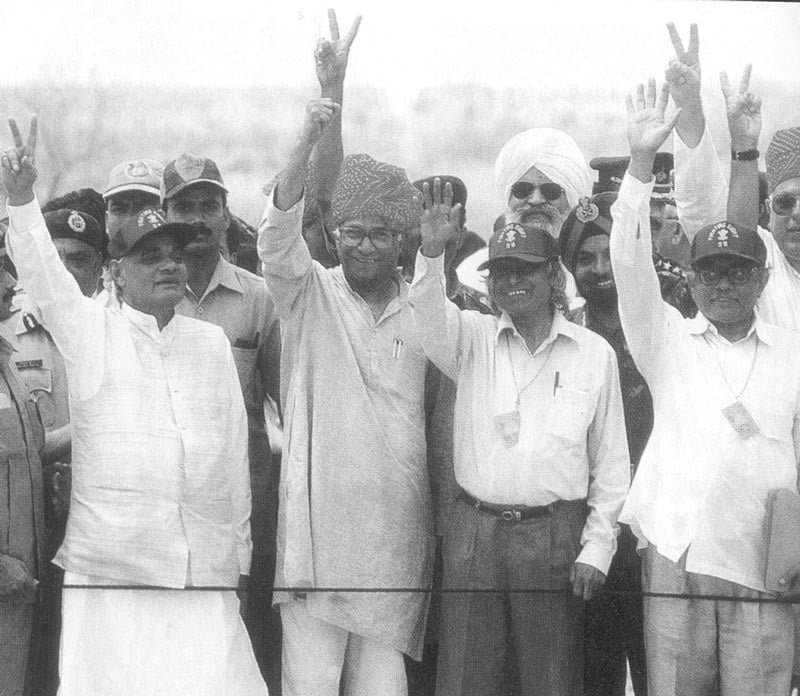
nuclear test was carried out
The underground nuclear tests carried out under the name Pokharan-2 proved that India is showing signs of self-reliance in connection with nuclear power. It is also worth mentioning here that after the 1974 Pokharan nuclear tests India’s nuclear weapon policy has come up strongly, and, at the same time it is also believed that the coming period will be of economic applications of nuclear weapons.
Many articles and remarks were published in various newspapers on the successful nuclear tests conducted by India. But the most important remark appeared in the newspaper ‘The Pioneer’ of 13th May—‘The credit of successful nuclear tests does not go to politicians alone. A number of scientists and visionaries like Homi Jehangir Bhabha and Dr. Abdul Kalam are also entitled to this honour. The history of their commitment and dedication should be written in golden letters.’