
As a result of the long struggle, countless sacrifices and martyrdoms, at last the country gained freedom from the British rule on 15 August, 1947.
Soon after, Dr. Radhakrishnan was sent to Russia (USSR) as India’s ambassador.
Then, the relations between the two countries were cold. It was a colonial legacy. The relations of the supremo of Russia, Marshal Stalin were strained with Britain. And being a British colonial state, Stalin considered India to be British stooge. In such cold environment Radhakrishnan went to Russia.
He through his wisdom and oratory made it clear to the Russians that Independent India was a different entity that suffered from no colonial hang over and had a mind and policies of its own based impartiality. He was able to win over Russians and Stalin. A historic process to bring Russia and India closer had been set in motion which later blossomed into a long lasting friendship between the two countries and saw India through several turbulent periods and wars. And on several occasions Russian veto saved the day for India in the Security Council of the UN on Kashmir issue.
While serving as the ambassador of India in Moscow he was running a side show as well. He used to lecture on the subject of ‘Comparative studies of the Religions’ in Oxford University. Under the arrangement he would visit Oxford University three times a year for 8 week periods each. Thus, he was spending almost six months in London every year.
Through his wisdom and eloquence Dr. Radhakrishnan had won the admiration of a stern and steely emotionless character like Joseph Stalin who belonged to a different ideology.
Once Stalin invited Dr. Radhakrishnan too among others for a kind of evening get together of the diplomatic corps.
During the chat Dr. Radhakrishnan quoted on Indian historic event related to Ashoka saying to Stalin, “In our country there has been a great Emperor who turned a Buddhist monk after a bloody war. You reached the pinnacle of power after a bloodshed, May be, you too will get immortalised like him in history.”
At this Joseph Stalin smiled and remarked, “Yes, sometimes, miracles do happen.”
After completing his innings in Moscow Dr. Radhakrishnan was taking leave of Moscow on 5 April, 1952. Russian foreign minister Vichinski gave farewell dinner in his honour.
After dinner Dr. Radhakrishnan went to meet Stalin to say good bye.
Stalin was not keeping well. His face was swollen. On an impulse, Dr. Radhakrishnan sympathetically caressed his swollen checks like a close relative or a bosom friend and patted his back encouragingly. Then he put his arm around Stalin’s neck.
Joseph Stalin looked at Radhakrishnan with tears in his eyes. He spoke, “You are the first person who treated me as a human being and didn’t consider me a monster like others. You are leaving us. That makes me sad. I wish you a long life. I don’t think I have much time left.”
And he didn’t live for long.
Dr. Radhakrishnan had a good wish and soft feelings for all others. He had no hatred or infatuation for a particular individual. He only took an ideology or a system as a subject for disapproval or commendation.
He stood for the women being given rightful respect in the society and the country to implant love, goodwill and harmony in life. He said that without pulling down the wall of apartheid between men and women there could be no peace, equality or goodwill.
According to Dr. Radhakrishnan, in ancient India women were accorded due respect unlike the rest of the societies where women were treated as play things. That was when at that period India reached the enviable height of social progress and glory. Our scriptures consider women to be worth worship. They were duly given education and training to hone their intellectual potential. As a result ancient Indian society was on the progressive highway.
In 1953, Dr. Radhakrishnan wrote in the preface of ‘Shardadevi Memorial Book’ stating the status of Indian woman—
‘In Indian tradition women have been looked upon as objects of reverence, although sometimes disrespectful words also have been used for them. In our ancient wisdom God has been visualised as a composite form of man-woman halves (vertically dichotomous), called ‘Ardhanarishwara’. Manu says that deities are propitious where women are worshiped and where they are looked down upon, there everything will go wrong.
Women also are human beings. Like men they too have the right to make full progress in every respect. For intellectual and spiritual growth we don’t care about the masculine gender. Similarly we must treat the faminine gender. The gender should not become a qualifying mark. Our being humans is more important than the gender difference. Within us, irrespective of sex, similar interaction between body and soul, limited and limitless goes on.
There are certain tasks which men do but the women can’t because their body composition being different is not suitable for those exercises. It does not mean that they are inferior. (There are many functions that women do but men can’t.) We must undertake the tasks we are made for and do them with full dedication.
In ancient India the education of women was specially encouraged. The goddess of learning, Saraswati is female. ‘Mahanirvana Tantra’ directs—‘In the upbringing and the education of a female child a great care and effort is required.’
Devi-Mahatmya says—‘All the knowledges are your different forms. All the women of the world are your different images’. Hindu mythology believes that all the knowledges, arts, sciences, crafts, powers, forces and energies are feminine phenomena. So, our mythology is replete with feminine names like Maitrayee, Gargi, Arundhati, Lilavati etc. besides the deified goddesses.
In the Vedic era the women had the right to education and work. They could become priests and join spiritual knowledge of the highest kind. Unfortunately in the later periods women’s education somehow come to be neglected and as a result women fell victim to illiteracy and consequent blindfaiths.
So much so that once Swami Vivekananda lamented that currently India was in no position to give birth to any woman of substance. So, it must borrow some great women from other societies. He got one in the form of Margaret Nobel, a German by birth who later became famous as Sister Nivedita. Over the period the state of the Indian women had gravely deteriorated.
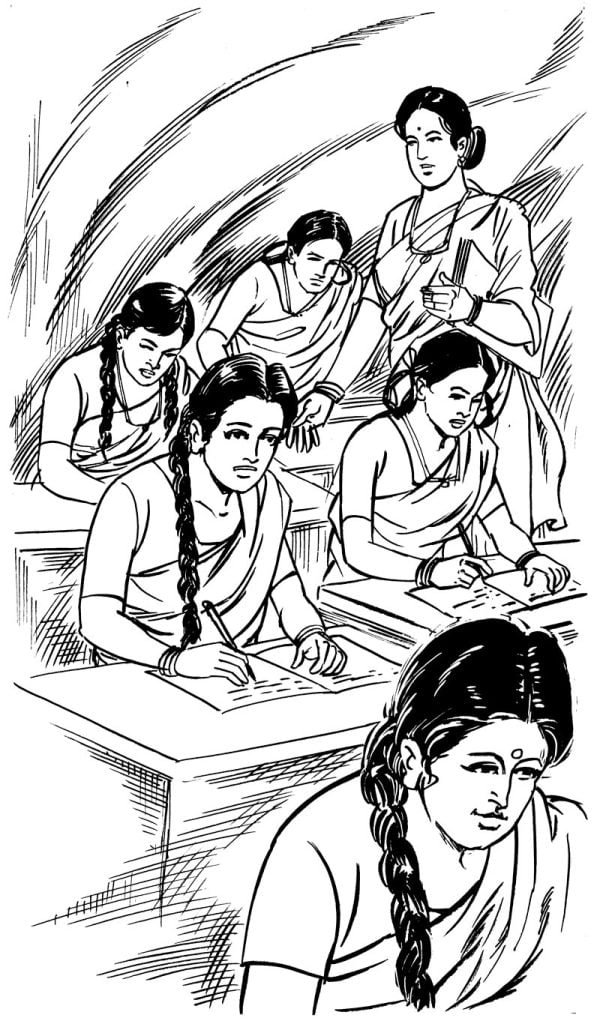
We forgot that the women also are humans and they too could execute great deeds given the chance. We insulted the potential talent of our women.
Today the situation has improved. The women are making remarkable progress. It is mainly due to Rama- krishna movement and the efforts made by Gandhiji. Ramakrishna used to advise his male devotees to forsake women and wealth and vice-versa in the case of the female devotees. He thought the sexual attraction could prove a distraction from the spiritual pursuit. A woman, Bhairavi Brahmani was his guru. He practically treated the woman as deities. It went a long way in restoring the honourable place of women in the society because Paramhansa was a very famous spiritual leader who had tens of millions of followers and admirers.
Gandhiji invoked women to join the freedom struggle. It brought women out of their domestic confines where the realisation dawned on them that they must share equal responsibility with men in every walk of life. To be able to do that it was their natural and national duty to get educated and worked for their own emancipation. The freedom struggle taught the women that they must fight a parallel battle for liberty from social injustices and prejudices. The woman in large numbers began to work in social services.
The marriage and motherhood are considered the natural duties of the women. In human history there always existed marriage and the family as basic social institution. We can’t imagine a society without them. The relationship of a man and a woman is the result of the natural basic instinct to multiply. One needs counterpart to carry forward the genes. The gender difference is a natural fact. It is not imaginary like the caste or racial difference. A pair of a man and a women is the basic social unit.
Indian tradition holds the marriage as a sacred custom. The women enjoyed the right to choose their life partner. Festivals were hold to give opportunity to the marriageable men and women to meet, interact and select the counterpart. There was well known tradition of swayamwara where the bride chose her groom. In certain cases women challenged the aspirants of marriage to debate or battle. Such daring women married only the males who managed to defeat them.
Then the marriage was a spiritual and intellectual union. The women were not merely means of casual pleasure. The sexual relationship was not a matter of condemnation. It was more like a sacred duty for the continuation of the family line and the society. Ancient Indians had a very healthy outlook.
There also existed people who instinctively thought that the women were pleasure things. They asked women to take men as the sole justification and the purpose of their existence. Westerners often say that eastern women are slaves. It really means that our women do not reveal their self respect. The inner nature of the eastern woman is different from that of the rest of the world. Traditions and religious culture preserves her feminine softness and tender feelings. She does charity but accepts none. They show courage where menfolk develop cold feet. They are full of love and obedient (to protect her man’s pride).
Men and women wish for offspring. The women have overpowering desire to become mother because in that lies the fructification of their womanhood which gives them a divine satisfaction which the men would never experience. It makes her even ignore the birthpangs. The desire for men is merely to fulfil the motherhood duty. The real face of the weaker sex is motherhood, femininity and leadership. A woman is the embodiment of the nature’s creative urge. She suckles, feeds, plays with, raises and educates her child as her prayer to Creator. Manu has said that a teacher is greater than a hundred books, father is more important than a hundred teachers and the mother is more educative than one hundred fathers.
Today the institutions of marriage and family are weakening which is a matter of concern. It is no saving grace that our country still is not taken over by evils as other countries are. Man-woman relationship should not be allowed to weaken. We need to raise the educational and moral standards for both men and women. A successful marriage is only possible if both the partners fulfil some basic moral and religious obligations. Our culture does not close the door of spiritual and intellectual pursuits on women. Those women who take the path of spiritualism or intellectualism become nuns in feelings and sentiments although not always physically. The purity is demanded of them. The wife of Ramakrishna Paramhansa, Shardadevi was perfect example of it. She herself led a saintly life.
According to Nivedita, Shardadevi was the physical manifestation of the holiest Indian women Ramakrishna would best dream of. Her piety, tolerance, patience and self discipline was incredible.
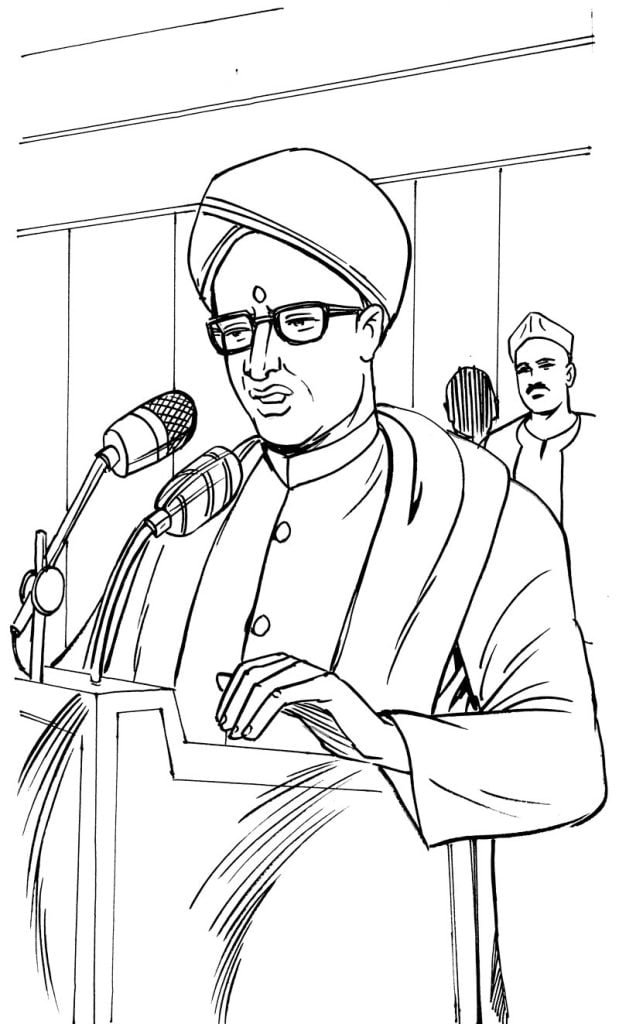
But most of the women prefer to remain domesticated and mothering. They are flag bearer and protectors of our culture. Even those who have got modern education do the household chores, patronise songs and folk poetry. They have their own particular kind of philosophy of life. Their own lives are the advertisements of Indian female culture. The incredible spirit of sacrifice makes them the leaders of non-violence. The world engulfed in wars must learn the art of peace from them.
The custom of child marriages was prevalent when Radhakrishnan was born. He was married at the age of 15 to a girl who was merely 10 year old. A scholar had written about his marriage—
‘It can’t be said that Dr. Radhakrishnan was totally against the custom of the child marriage. He just wanted some reforms. He held the view that compared to Europe here marriages take place in younger age. But these marriages do not fail (whatever the other negative fall outs). Hindu mindset of the wife is uniquely evolved over the centuries. It is ideal, generous and sublime. Through her own inner logic she demands her right with subtlety. Hindu wives are inspired by traditional ideals. The husband is her life. If the husband is non-believer she compensates by adding extra in her own faith and more firmness in her beliefs.’
The people and families come together to create a society which goes on to make a nation. Several nations of the world joined hands to create UNO, with the aim to generate goodwill, cooperation, friendships and peace among the nations.
On 24 October, 1953 on the occasion of UN Day he addressed the nation on All India Radio explaining the aims of the world body—
‘The aims of the UNO is listed in the introduction to the Charter which was signed on 26 June, 1945 in San Francisco—
‘We, the people of United Nations, with the aim to save the future generations of the world from the holocaust of war, which in our own life time, twice plunged the mankind in unimaginable griefs and sorrows, to rekindle the faith in fundamental human rights…and to create such environment, where the justice, and respect to those duties are perpetuated, which spring from the process of treaties and international law, with a firm resolve we decide to make it a common endeavour to fulfil those objectives. That was what the UNO was set up for.
It is a matter of joy to have common platform like the UNO because it represents a new hope and the wish for a better new world. Our past behaviours, views, speeches and the way of business created an atmosphere which was not conducive to peace and the prosperity. UNO will remove that negative environment. If the ray of hope shown by the UN does not spread to destroy the darkness and the air of suspicion, fear and bitterness still persists, then we must ourselves find the answers.
When we see at the world situation we find that the big powers are entangled in such imbroglios that can lead to total war, where they make friends and create and encourage explosive movements in the unfriendly nations to try to set up military bases there, it gives us great anxiety and disappointment. An individual can work for the downfall of another individual, but a government whose policy is based on military power and opportunism can lead to the degeneration of entire nation. It is not possible to escape from the consequences of war when we keep stock-piling weapons and calling the people to war. Now, either these will be a big explosion to destroy us all or we make combined effort to work for the world peace and the progress of all. It is only possible when the signatory nations of the UN charter base their internal and external policies honestly in conformation with the UN principles.
The services rendered by the UNO in the cases of Philippines, Indonesia, Kashmir and Korea in solving the problems are well known to us. Its specific committees have done a commendable job in various fields especially in improving the standards of education and health. Inspite of these achievements UNO is losing its moral authority. The general impression emerging is that UN’s history from its inception to the present time has been full of failures, weaknesses, distortion of its original objectives and violations of serious decisions.
Inspite of being members of the UN most of the governments of those countries are more nationalistic than internationalists. Increasing nationalism of the independent countries is the manifestation of feeling of fear and insecurity. If internationalism creates the feeling of security the fear will go away. But little effort is being made to remove the feelings of fear and the insecurity.
The countries of Asia and Africa that still are under foreign domination, their people who are striving to gain freedom belong to old traditions whereas their political aspirations are new. They are sensitive and proud people notwithstanding the poverty, hunger, slavery and being powerless. The more their aspiration of freedom is crushed the more it flares up. Those who are suffering slavery can’t be expected to understand the importance of internationalism or universality. By refusing to aid the freedom movements and sympathising with them, without trying to impose our hegemony there, we must make the UNO means to create conditions conducive to the peaceful transfer of power to the natives. If the colonialism, corruption and non-representative governments are supported through military aid in contravention of the human rights, then it poses serious danger for the world peace.
If the declaration of human rights is not to become meaningless it should not remain merely words on a paper. UNO must implement its basic ideals practically. Those who are victims of racial discrimination, who are unable to fight back, we can not expect them to love their tormentors. The UN committee on science, education and culture has conducted a research recently and found that no race is born superior over other. The racial problems can not be solved overnight with a magic wand. But apartheid is no solution. We must work for friendship and mutual respect between different races and no group should be allowed to exploit others.
It is a general opinion today that UNO is no more an organisation that functions independently. Its actions are under the influence of power pressures and power block tensions. Under the very roof on UNO some countries are running campaigns to abuse and defame the opponents. It is generating hatred, fear and animosity. The threats, intimidation and inducements can never be means of treaties between the free nations. We need not think that those whose beliefs are different from ours are different species or are bigger evil than we are. Basically we are all alike.
In Soviet Union the governments is very organised and the opposition is ruthlessly crushed. May be, we don’t approved the communist physical theories or the way it is forced upon the people. But the countries who have opted for communist rule, there it only means education, opportunities and equality in theory. It may make life harsh but it is no more worse than what the situation earlier was.
The communists realise the necessity of a new social order in the countries where poverty and luxuryful life are existing side by side. It is meaningless to teach individual freedoms and the human rights to a starving farmer or exploited to the bones worker. We should not hope for them to accept democracy that had ignored his woes or turned a blind eye when he was being exploited. After all democracy will merely ask him to wait indefinitely for the better luck. The fear of communism has misled us about the realities of the world.
The helpers of communism are dictatorships and reactionary individuals who are against political freedom, social equality and economic progress. The hungry and poor masses can be weaned away from the lure of communism only if democracies implement their ideals honestly to create an example.
It is a mental sickness to believe that only we know the real truth and those who don’t agree with our viewpoint are wrong and evil ones. In this fast changing world we must not stick to a fixed view point. We shouldn’t be prisoners of our own hard policies—and thinking. The pig-headedness is not virtue or hallmark of sanctity.
The democratic system is very suitable for us Indians who traditionally are believers in non-violence, religiousness and personal liberties. We have learnt to coexist with others. We believe in being friends with those whose viewpoints and systems are different from ours.
The UNO promises to help us to live peacefully with those whose faith is different and ideologies too. It is possible because we are all human beings and our interests are common. Creating peace organisations is difficult than making wars. It demands patience. Tolerance and goodwill are prerequisites. We can hope to develop the means and spirit to use the rationale and cooperation by nursing these qualities.
We must use politeness against invectives, rationale against hurdles, trust against suspicion and goodwill against hatred. Behind this logic is the belief that every human has a fragment of God in him which can be invoked to prevail over negative aspects. If we are to calm our nerves, reduce the cold war tensions, follow ‘live and let live’ ideal and work for the human survival, then we must adopt democratic spirit which we hope to be reciprocated.
A united world is better than the divided world. But a divided world is preferable to the destroyed world. For a period Churchil supported the meeting of the world powers. The door to a meeting can only be a door of peace. We may question and suspect the intentions of our rivals but it is the duty of the UNO to understand the opponents and allay their fears and suspicious to change mindsets. It can change their thinking including that of Soviet Union. The communists may one day understand that the spiritual realities are as important as the physical realities. There are some moral and spiritual values without which we can’t emotionally survive. A time will come when communism will democratise itself.
The most sensible real politics demands that our behaviour should be religious. In this age of impasses and fears we must not forget the basic value of all religions that the victory over evil can only be achieved with goodness.
India does not wish to join any power block. It does not want to promise its support to anyone unconditionally and in advance. India will always be on the side of the peace, democracy and mankind. Thus, we want to contribute our bit in peaceful solution of the problems that are creating chasms between the power blocks.
India does not think every nation should take sides in the present cold war.
USA must sympathise with this attitude of several Asian countries because it has been their long tradition of nonalignment and not joining any power block. Both the blocks have misunderstood India’s effort to bridge the opposite blocks and have criticised our stand. Korea is one example. And the bridge is something that both the sides can use.
The foundation of peace should be laid on goodwill to all, patience and dedication. We strongly are striving to get communist China in the UNO. It will strengthen the peace process. The world body will become more representative of the mankind. Almost all nations, thus would become the part of the organisation, reduce tension and Chinese people would again see ray of hope.
At this hour the mankind is in a state of mind where it is receptive to new viewpoints. The traditions are losing their hold. The revolutionary change is not only in the air but it has entered the hearts of the people. We can create a new world order based on faith, system and human self respect, the very ingredients of social power.
The new order is symbolised by the UNO.
It may appear a pipe dream but still it is better than the nightmare we were living in. We should make every effort to realise this dream. We should not be put off by temporary setbacks. We don’t take all the endeavours ruling out any failures. It is better to face failure in trying a noble venture than achieving success in some evil goal.
Truth will prevail in end, Satyameva Jayate.’
After his return from Moscow Dr. Radhakrishnan was elected Vice President of India by consensus. At last the country had recognised the merits of its scholarly son. He became Chairman of Rajya Sabha as well, as is prescribed by our constitutional provisions.
Then the upper House (Rajya Sabha) was an prestigious body. His induction made it more graceful as Dr. Radhakrishnan’s scholarly and lofty character had the touch of serene nobility which rubbed on to the august body.
Dr. Radhakrishnan’s philosophical thoughts were respected not only in India but abroad as well. His speech drew attentive listeners whenever he spoke. His ideas were discussed all over the world and they had made waves at the elite level. He earned respect for his country as well.
So, duly recognising his services to the nation, he was conferred the country’s highest award, ‘Bharat Ratna’ in 1954. He indeed was the gem of India He wished success for himself as well as for others.
He deeply believed in co-existence. Once in a diplomatic meeting on 7 July, 1956 he said—
“India is not merely the name of a piece of land but it is an attitude, an ideology and a way of living. In contrast to the history of Egypt and Babylone (3250 B.C.) India evolved a different civilisation and social ideals which still go on as the cultural values and life styles. The ancient Egypt was very different from the modern Egypt. But ancient India was more or less just like modern India in the way of thinking, habits, living and adheres to the same customs, traditions and religious belief.
In the excavations of Harappa and Mohenjodaro an ancient Shiva idol has been found. Shiva is in a meditational posture atop a lotus flower and several creatures surrounding the lotus. In that set up we can see the fundamental ideology that has influenced our spiritual environment. It shows the principle of one vanquishing the carnal desires and weaknesses through spiritual power is superior to one who is victorious in battle fields. The victory over inner weakness is far greater that victory over lands or countries.
Our firm belief is that great are the ones who win over enemies without using physical force.
From that era to this era we find the same basic value as depicted in that Shiva idol. Ancient Egypt had different religion and different God from Today’s Islamist Egypt. But India continues with the same Shiva, same posture and same mind. Buddha came and preached same meditative postures and conqerred half of the mankind. Guru Nanak followed with the same message of peace, compassion, co-existence and mercy. Other saints and fakirs carried forward the same ideas. India never waivers in its fundamental beliefs.
It is not a matter of much importance to us what religion worship God in what manner and through what rituals one demonstrates his faith. For us the importance of religion is that it should help improve our nature, change our personality for the better and to refine us to upgrade as a human being from what we are today. True religion is unification with the last mystery of the world.
When we look at the religions from that angle the clashes between faiths and opposition of beliefs become meaningless. Several ways have been prescribed to achieve that sublime religious goal from that day to this day.
Thus, we have always been upholding the principle of peaceful, active and interactive coexistence. When we say that our country is secular that does not mean that we are materialistic and worship the objects of pleasures and luxury or we don’t believe in the higher principles than the material values that rule the physical world. Our being secular only means that we are not partial to any particular religion. We respect all religions and believe in interactive co-existance of all religions in a peaceful environment. Bigotism and communalism has no place in this country. There will be no argument or communal clash as long as we think that various religious tenets are merely different ways to reach Creator and they are not the final answer about truth. Aryans, Dravids, Hindus and Buddhists, whoever came into India got melted into one body.
There are other view points that come to us. If we look at the west we find that the history of Europe begins with the differences between Greeks and the barbarians. But in reality Greeks have borrowed a number of ideas from so called barbaric countries namely Egypt, Iran and Babylon. A little further look shows us that Justinian closed down schools of Athens thinking that Greece and Galilee won’t be able to live together.
Augustine is all Plato and Plotinus. Aquinos is full of Aristotle. In the middle age crusades Christians and Muslims were involved. There was talk of a thousand years war. The two religions involved in the same region and having common characters could have easily co-exited and learnt a lot from each other.
The modern renaissance of Europe is the result of the knowledge that reached there through Arabic translators of the great epics of Greece. Those two Muslim theologist translators, Avroz and Avisenna contributed a lot to the evolution of Christian ideology.
For centuries in medieval era Christian Catholics and Protestants fought pitched battles. Each faction continued to believe that it was the one who was on the right side. Today we see that Catholics and Protestants are co-existing as the wisdom prevailed. The wisdom is to co-exist, help each other and learn from each other.
For ages the same wisdom has been our fundamental principle.
Now we are thinking of interactive co-existence. The traditions of this and that have created clashes but now we hope it to apply balm to the wounds of the nations. This very tradition is borne of the belief that we have found out the truth and it is our duty to spread it to the ones who don’t know it yet.
This tradition says that there is no corner of the earth where there are no people who have experienced God. Every human being has the right to the mercy and the love of God. Infact, there are no people who have been forsaken by God. Koran says—‘Messengers have been sent to all people to teach them the way to pay obeisance to Creator’. So, if we believe in the omnipresence of God and accept it, then, interactive co-existence becomes a practical wisdom.
Now we know that ‘this-that’ tradition is utterly foolish. There was a time when we used to wage wars to force our own faith on others successfully.
Gone are those days.
Today’s bomb dropping war planes do not make any distinction between the faithfuls of different religions down there. Atom bombs won’t even distinguish nationalities. We have reached a stage when with a finger’s push on a button entire continent can be obliterated. In this race for devilish weapons there is little possibility that we shall be able to save our faiths whatever.
We have begun to realise that we shall live or die together. And if we want to live together then, it is essential that we learn to respect and be tolerant to beliefs of others. For survival religious tolerance and tolerance as basic principle are imperative. Mercifulness is the greatest form of love.
So, if we want to accept the philosophy of interactive co-existence, we shall have to rid ourselves of the arrogant thought that we own the light and all others are groping in the dark. India has suffered because of this policy of peaceful co-existence. But never mind, if we hold our right stand we might have to pay some price.
Holy Cross is the symbol of Christianity. Christ had to suffer physical defeat to gain moral victory. So, we feel we must understand that if we are on the right path, we are not doing it to achieve success, but we do it because we know that we are right. In many countries many races, communities and people of different faiths are living together. Let us hope that in those countries the process of interactive co-existence will continue and intolerance will never show up.
I have no doubt that at this hour the prevailing philosophy of our country does not believe in boycott, segregation or mergers. It does believe in friendship between racial groups and communities but it requires a fresh look at life from a new angle from others. We must respect every individual.
That individual may not be tall like you, he may not be as wise, lettered or experienced as you are according to your own assessment. You could be wrong. That person can have some untapped talents or secret powers or unflaunted capabilities which may manifest after some time. After all we are living in an enigmatic world, full of incredible possibilities.
We should follow the philosophy of a country that says that it is helping every individual to grow to his full potential. We must create an environment and conditions where everyone can explore the limits of one’s potentials. The world today need the philosophy of co-existence based on action, interaction and cooperation.