
Chapter 13
The weariest nights, the longest days, sooner or later must perforce come to an end.
Marguerite had spent over fifteen hours in such acute mental torture as well-nigh drove her crazy. After a sleepless night, she rose early, wild with excitement, dying to start on her journey, terrified lest further obstacles lay in her way. She rose before anyone else in the house was astir, so frightened was she, lest she should miss the one golden opportunity of making a start.
When she came downstairs, she found Sir Andrew Ffoulkes sitting in the coffee-room. He had been out half an hour earlier, and had gone to the Admiralty Pier, only to find that neither the French packet nor any privately chartered vessel could put out of Dover yet. The storm was then at its fullest, and the tide was on the turn.
If the wind did not abate or change, they would perforce have to wait another ten or twelve hours until the next tide, before a start could be made. And the storm had not abated, the wind had not changed, and the tide was rapidly drawing out.
Marguerite felt the sickness of despair when she heard this melancholy news. Only the most firm resolution kept her from totally breaking down, and thus adding to the young man’s anxiety, which evidently had become very keen.
Though he tried to hide it, Marguerite could see that Sir Andrew was just as anxious as she was to reach his comrade and friend. This enforced inactivity was terrible to them both.
How they spend that wearisome day at Dover, Marguerite could never afterwards say. She was in terror of showing herself, lest Chauvelin’s spies happened to be about, so she had a private sitting-room, and she and Sir Andrew sat there hour after hour, trying to take, at long intervals, some perfunctory meals, which little Sally would bring them, with nothing to do but to think, to conjecture, and only occasionally to hope.
The storm had abated just too late; the tide was by then too far out to allow a vessel to put off to sea. The wind had changed, and was settling down to a comfortable north-westerly breeze—a veritable godsend for a speedy passage across to France.
And there those two waited, wondering if the hour would ever come when they could finally make a start. There had been one happy interval in this long weary day, and that was when Sir Andrew went down once again to the pier, and presently came back to tell Marguerite that he had chartered a quick schooner, whose skipper was ready to put to sea the moment the tide was favourable.
From that moment the hours seemed less wearisome; there was less hopelessness in the waiting; and at last, at five o’clock in the afternoon, Marguerite, closely veiled and followed by Sir Andrew Ffoulkes, who, in the guise of her lacquey, was carrying a number of impedimenta, found her way down to the pier.
Once on board, the keen, fresh sea-air revived her, the breeze was just strong enough to nicely swell the sails of the FOAM CREST, as she cut her way merrily towards the open.
The sunset was glorious after the storm, and Marguerite, as she watched the white cliffs of Dover gradually disappearing from view, felt more at peace and once more almost hopeful.
Sir Andrew was full of kind attentions, and she felt how lucky she had been to have him by her side in this, her great trouble.
Gradually the grey coast of France began to emerge from the fast-gathering evening mists. One or two lights could be seen flickering, and the spires of several churches to rise out of the surrounding haze.
Half an hour later Marguerite had landed upon French shore. She was back in that country where at this very moment men slaughtered their fellow-creatures by the hundreds, and sent innocent women and children in thousands to the block.
The very aspect of the country and its people, even in this remote sea-coast town, spoke of that seething revolution, three hundred miles away, in beautiful Paris, now rendered hideous by the constant flow of the blood of her noblest sons, by the wailing of the widows, and the cries of fatherless children.
The men all wore red caps—in various stages of cleanliness—but all with the tricolor cockade pinned on the left-side. Marguerite noticed with a shudder that, instead of the laughing, merry countenance habitual to her own countrymen, their faces now invariably wore a look of sly distrust.
Every man nowadays was a spy upon his fellows: the most innocent word uttered in jest might at any time be brought up as a proof of aristocratic tendencies, or of treachery against the people. Even the women went about with a curious look of fear and of hate lurking in their brown eyes; and all watched Marguerite as she stepped on shore, followed by Sir Andrew, and murmured as she passed along: ‘SACRES ARISTOS!’ or else ‘SACRES ANGLAIS!’
So, perhaps, as Sir Andrew gradually directed Marguerite through the tortuous streets of Calais, many of the population, who turned with an oath to look at the strangers clad in English fashion, thought that they were bent on purchasing dutiable articles for their own fog-ridden country, and gave them no more than a passing thought.
Marguerite, however, wondered how her husband’s tall, massive figure could have passed through Calais unobserved: she marvelled what disguise he assumed to do his noble work, without exciting too much attention.
But she did not heed any of these petty discomforts: “We may meet Blakeney at the `Chat Gris,’” Sir Andrew had said, when they landed, and she was walking as if on a carpet of rose-leaves, for she was going to meet him almost at once.
At last they reached their destination. Sir Andrew evidently knew the road, for he had walked unerringly in the dark, and had not asked his way from anyone. It was too dark then for Marguerite to notice the outside aspect of this house. The ‘Chat Gris,’ as Sir Andrew had called it, was evidently a small wayside inn on the outskirts of Calais, and on the way to Gris Nez. It lay some little distance from the coast, for the sound of the sea seemed to come from afar.
The paper, such as it was, was hanging from the walls in strips; there did not seem to be a single piece of furniture in the room that could, by the wildest stretch of imagination, be called ‘whole.’ Most of the chairs had broken backs, others had no seats to them, one corner of the table was propped up with a bundle of faggots, there where the fourth leg had been broken.
In one corner of the room there was a huge hearth, over which hung a stock-pot, with a not altogether unpalatable odour of hot soup emanating therefrom. On one side of the room, high up in the wall, there was a species of loft, before which hung a tattered blue-and-white checked curtain. A rickety set of steps led up to this loft.
On the great bare walls, with their colourless paper, all stained with varied filth, there were chalked up at intervals in great bold characters, the words: ‘Liberte—Egalite—Fraternite.’
The whole of this sordid abode was dimly lighted by an evil-smelling oil-lamp, which hung from the rickety rafters of the ceiling. It all looked so horribly squalid, so dirty and uninviting, that Marguerite hardly dared to cross the threshold. Sir Andrew, however, had stepped unhesitatingly forward.
“English travellers, citoyen!” he said boldly, and speaking in French.
“Oh, lud!” said Marguerite, as she advanced into the room, holding her handkerchief to her dainty nose, “what a dreadful hole! Are you sure this is the place?”
“Aye! this the place, sure enough,” replied the young man as, with his lace-edged, fashionable handkerchief, he dusted a chair for Marguerite to sit on; “but I vow I never saw a more villainous hole.”
“Faith!” she said, looking round with some curiosity and a great deal of horror at the dilapidated walls, the broken chairs, the rickety table, “it certainly does not look inviting.”
The landlord of the ‘Chat Gris’—by name, Brogard—had taken no further notice of his guests; he concluded that presently they would order supper, and in the meanwhile it was not for a free citizen to show deference, or even courtesy, to anyone, however smartly they might be dressed.
By the hearth sat a huddled-up figure clad, seemingly, mostly in rags: that figure was apparently a woman, although even that would have been hard to distinguish, except for the cap, which had once been white, and for what looked like the semblance of a petticoat. She was sitting mumbling to herself, and from time to time stirring the brew in her stock-pot.
“Hey, my friend!” said Sir Andrew at last, “we should like some supper. The citoyenne there,” he added, “is concocting some delicious soup, I’ll warrant, and my mistress has not tasted food for several hours.
It took Brogard some few minutes to consider the question. A free citizen does not respond too readily to the wishes of those who happen to require something of him.
“SACRRRES ARISTOS!” he murmured, and once more spat upon the ground.
Then he went very slowly up to a dresser which stood in a corner of the room; from this he took an old pewter soup-tureen and slowly, and without a word, he handed it to his better-half, who, in the same silence, began filling the tureen with the soup out of her stock-pot.
Marguerite had watched all these preparations with absolute horror; were it not for the earnestness of her purpose, she would incontinently have fled from this abode of dirt and evil smells.
“Faith! our host and hostess are not cheerful people,” said Sir Andrew, seeing the look of horror on Marguerite’s face. “I would I could offer you a more hearty and more appetising meal but I think you will find the soup eatable and the wine good; these people wallow in dirt, but live well as a rule.”
“Nay! I pray you, Sir Andrew,” she said gently, “be not anxious about me. My mind is scarce inclined to dwell on thoughts of supper.”
Brogard was slowly pursuing his gruesome preparations; he had placed a couple of spoons, also two glasses on the table, both of which Sir Andrew took the precaution of wiping carefully.
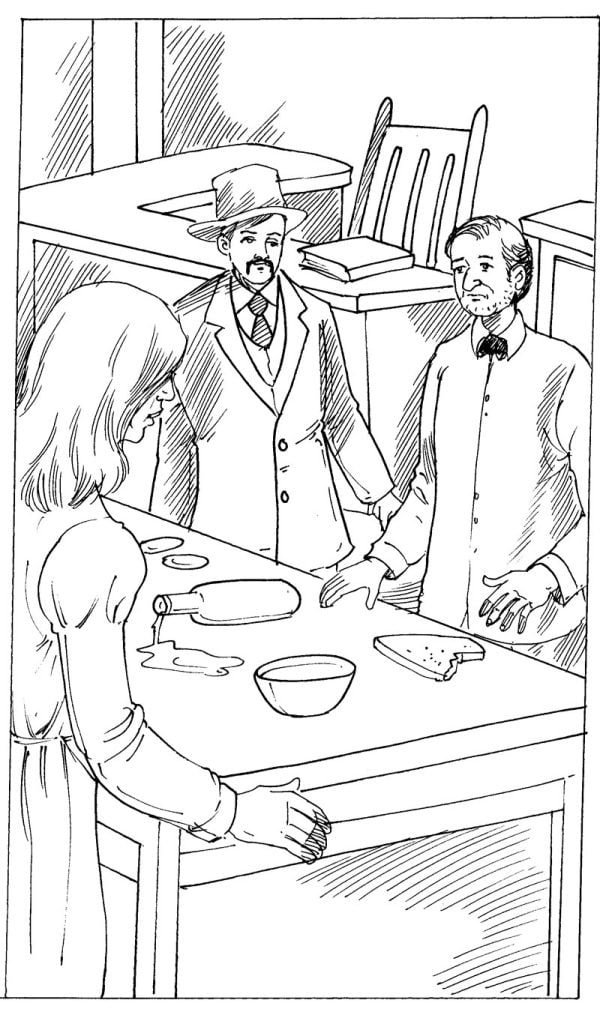
Brogard had also produced a bottle of wine and some bread, and Marguerite made an effort to draw her chair to the table and to make some pretence at eating. Sir Andrew, as befitting his role of lacquey, stood behind her chair.
“Nay, Madame, I pray you,” he said, seeing that Marguerite seemed quite unable to eat, “I beg of you to try and swallow some food—remember you have need of all your strength.”
The soup certainly was not bad; it smelt and tasted good. Marguerite might have enjoyed it, but for the horrible surroundings. She broke the bread, however, and drank some of the wine.
“Nay, Sir Andrew,” she said, “I do not like to see you standing. You have need of food just as much as I have. This creature will only think that I am an eccentric Englishwoman eloping with her lacquey, if you’ll sit down and partake of this semblance of supper beside me.”
Indeed, Brogard having placed what was strictly necessary upon the table, seemed not to trouble himself any further about his guests. The Mere Brogard had quietly shuffled out of the room, and the man stood and lounged about, smoking his evil-smelling pipe, sometimes under Marguerite’s very nose, as any free-born citizen who was anybody’s equal should do.
“Confound the brute!” said Sir Andrew, with native British wrath, as Brogard leant up against the table, smoking and looking down superciliously at these two SACRRRES ANGLAIS.
“In Heaven’s name, man,” admonished Marguerite, hurriedly, seeing that Sir Andrew, with British-born instinct, was ominously clenching his fist, “remember that you are in France, and that in this year of grace this is the temper of the people.”
“I’d like to scrag the brute!” muttered Sir Andrew, savagely.
He had taken Marguerite’s advice and sat next to her at table, and they were both making noble efforts to deceive one another, by pretending to eat and drink.
“I pray you,” said Marguerite, “keep the creature in a good temper, so that he may answer the questions we must put to him.”
“I’ll do my best, but, begad! I’d sooner scrag him than question him. Hey! my friend,” he said pleasantly in French, and tapping Brogard lightly on the shoulder, “do you see many of our quality along these parts? Many English travellers, I mean?”
Brogard looked round at him, over his near shoulder, puffed away at his pipe for a moment or two as he was in no hurry, then muttered, Marguerite tried not to look at Brogard, lest she should betray before him the burning anxiety with which she waited for his reply. But a free-born French citizen is never in any hurry to answer questions: Brogard took his time, then he said very slowly, “Tall Englishman?—To-day!—Yes.”
“Yes, to-day,” muttered Brogard, sullenly. Then he quietly took Sir Andrew’s hat from a chair close by, put it on his own head, tugged at his dirty blouse, and generally tried to express in pantomime that the individual in question wore very fine clothes. ‘SACRRE ARISTO!’ he muttered, “that tall Englishman!”
Marguerite could scarce repress a scream.
“It’s Sir Percy right enough,” she murmured, “and not even in disguise!”
She smiled, in the midst of all her anxiety and through her gathering tears, at the thought of “the ruling passion strong in death”; of Percy running into the wildest, maddest dangers, with the latest-cut coat upon his back, and the laces of his jabot unruffled.
“Oh! the foolhardiness of it!” she sighed. “Quick, Sir Andrew! ask the man when he went.”
“Ah yes, my friend,” said Sir Andrew, addressing Brogard, with the same assumption of carelessness, “my lord always wears beautiful clothes; the tall Englishman you saw, was certainly my lady’s friend. And he has gone, you say?”
“He went. Yes, but he’s coming back. Here—he ordered supper.”
Sir Andrew put his hand with a quick gesture of warning upon Marguerite’s arm; it came none too sone, for the next moment her wild, mad joy would have betrayed her. He was safe and well, was coming back here presently, she would see him in a few moments perhaps. Oh! the wildness of her joy seemed almost more than she could bear.
“Here!” she said to Brogard, who seemed suddenly to have been transformed in her eyes into some heavenborn messenger of bliss. “Here!—did you say the English gentleman was coming back here?”
The heaven-born messenger of bliss spat upon the floor, to express his contempt for all and sundry ARISTOS, who chose to haunt the “Chat Gris.”
“Heu!” he muttered, “he ordered supper—he will come back, SACRRE ANGLAIS!” he added, by way of protest against all this fuss for a mere Englishman.
“But where is he now? Do you know?” she asked eagerly, placing her dainty white hand upon the dirty sleeve of his blue blouse.
“He went to get a horse and cart,” said Brogard, laconically, as with a surly gesture, he shook off from his arm that pretty hand which princes had been proud to kiss.
“At what time did he go?”
“I don’t know,” he said surlily. “I have said enough, VOYONS, LES ARISTOS! He came to-day. He ordered supper. He went out. He’ll come back. VOILA!”
And with this parting assertion of his rights as a citizen and a free man, to be as rude as he well pleased, Brogard shuffled out of the room, banging the door after him.
“Faith, Madame!” said Sir Andrew, seeing that Marguerite seemed desirous to call her surly host back again, “I think we’d better leave him alone. We shall not get anything more out of him, and we might arouse his suspicions. One never knows what spies may be lurking around these God-forsaken places.”
“What care I?” she replied lightly, “now I know that my husband is safe, and that I shall see him almost directly!”
“Hush!” he said in genuine alarm, for she had talked quite loudly, in the fulness of her glee, “the very walls have ears in France, these days.”
He rose quickly from the table, and walked round the bare, squalid room, listening attentively at the door, through which Brogard has just disappeared, and whence only muttered oaths and shuffling footsteps could be heard. He also ran up the rickety steps that led to the attic, to assure himself that there were no spies of Chauvelin’s about the place.
“Are we alone, Monsieur, my lacquey?” said Marguerite, gaily, as the young man once more sat down beside her. “May we talk?”
“As cautiously as possible!” he entreated.
“Nay, madam! that I fear we do not know.”
“What do you mean?”
“He was at Dover at the same time that we were.”
“Held up by the same storm, which kept us from starting.”
“Exactly. But I did not speak of it before, for I feared to alarm you—I saw him on the beach not five minutes before we embarked. At least, I swore to myself at the time that it was himself; he was disguised as a CURE, so that Satan, his own guardian, would scarce have known him. But I heard him then, bargaining for a vessel to take him swiftly to Calais; and he must have set sail less than an hour after we did.”
This much Marguerite had fully understood from the first, and Sir Andrew Ffoulkes had confirmed her surmises. She knew, too, that when Sir Percy realized that his own plans and his directions to his lieutenants had been stolen by Chauvelin, it was too late to communicate with Armand, or to send fresh instructions to the fugitives.
They would, of necessity, be at the appointed time and place, not knowing how grave was the danger which now awaited their brave rescuer.
Blakeney, who as usual had planned and organized the whole expedition, would not allow any of his younger comrades to run the risk of almost certain capture. Hence his hurried note to them at Lord Grenville’s ball—“Start myself to-morrow—alone.”
There was but one hour—the hour’s start which Marguerite and Sir Andrew had of their enemy—in which to warn Percy of the imminence of his danger, and to persuade him to give up the foolhardy expedition, which could only end in his own death.
But there was that one hour.
“Chauvelin knows of this inn, from the papers he stole,” said Sir Andrew, earnestly, “and on landing will make straight for it.”
“He has not landed yet,” she said, “we have an hour’s start on him, and Percy will be here directly. We shall be mid-Channel ere Chauvelin has realised that we have slipped through his fingers.
She spoke excitedly and eagerly, wishing to infuse into her young friend some of that buoyant hope which still clung to her heart. But he shook his head sadly.
“Silent again, Sir Andrew?” she said with some impatience. “Why do you shake your head and look so glum?”
“Faith, Madame,” he replied, “it is only because in making your rose-coloured plans, you are forgetting the most important factor.”
“What in the world do you mean? I am forgetting nothing. What factor do you mean?” she added with more impatience.
“It stands six foot odd high,” replied Sir Andrew, quietly, “and hath name Percy Blakeney.”
“I don’t understand,” she murmured.
“Do you think that Blakeney would leave Calais without having accomplished what he set out to do?”
“You mean?”
“There’s the old Comte de Tournay.”
“The Comte?” she murmured.
“And St. Just and others.”
“My brother!” she said with a heart-broken sob of anguish. “Heaven help me, but I fear I had forgotten.” “Fugitives as they are, these men at this moment await with perfect confidence and unshaken faith the arrival of the Scarlet Pimpernel, who has pledged his honour to take them safely across the Channel.
Indeed, she had forgotten! With the sublime selfishness of a woman who loves with her whole heart, she had in the last twenty-four hours had no thought save for him. His precious, noble life, his danger—he, the loved one, the brave hero, he alone dwelt in her mind.
“My brother!” she murmured, as one by one the heavy tears gathered in her eyes, as memory came back to her of Armand, the companion and darling of her childhood, the man for whom she had committed the deadly sin, which had so hopelessly imperilled her brave husband’s life.
“Sir Percy Blakeney would not be the trusted, honoured leader of a score of English gentlemen,” said Sir Andrew, proudly, “if he abandoned those who placed their trust in him. As for breaking his word, the very thought is preposterous!”

There was silence for a moment or two. Marguerite had buried her face in her hands, and was letting the tears slowly trickle through her trembling fingers. The young man said nothing; his heart ached for this beautiful woman in her awful grief. All along he had felt the terrible impasse in which her own rash act had plunged them all. He knew his friend and leader so well, with his reckless daring, his mad bravery, his worship of his own word of honour. Sir Andrew knew that Blakeney would brave any danger, run the wildest risks sooner than break it, and with Chauvelin at his very heels, would make a final attempt, however desperate, to rescue those who trusted in him.
“Undoubtedly. He has wonderful resources at his command. As soon as he is aware of his danger he will exercise more caution: his ingenuity is a veritable miracle.”
“Then, what say you to a voyage of reconnaissance in the village whilst I wait here against his coming!—You might come across Percy’s track and thus save valuable time. If you find him, tell him to beware!—his bitterest enemy is on his heels!”
“But this is such a villainous hole for you to wait in.”
“Nay, that I do not mind!—But you might ask our surly host if he could let me wait in another room, where I could be safer from the prying eyes of any chance traveller. Offer him some ready money, so that he should not fail to give me word the moment the tall Englishman returns.”
She spoke quite calmly, even cheerfully now, thinking out her plans, ready for the worst if need be; she would show no more weakness, she would prove herself worthy of him, who was about to give his life for the sake of his fellow-men.
Sir Andrew obeyed her without further comment. Instinctively he felt that hers now was the stronger mind; he was willing to give himself over to her guidance, to become the hand, whilst she was the directing hand.
He went to the door of the inner room, through which Brogard and his wife had disappeared before, and knocked; as usual, he was answered by a salvo of muttered oaths.
“Hey! friend Brogard!” said the man peremptorily, “my lady friend would wish to rest here awhile. Could you give her the use of another room? She would wish to be alone.”
He took some money out of his pocket, and allowed it to jingle significantly in his hand. Brogard had opened the door, and listened, with his usual surly apathy, to the young man’s request. At the sight of the gold, however, his lazy attitude relaxed slightly; he took his pipe from his mouth and shuffled into the room.
He then pointed over his shoulder at the attic up in the wall.
“She can wait up there!” he said with a grunt. “It’s comfortable, and I have no other room.”
“Nothing could be better,” said Marguerite in English; she at once realised the advantages such a position hidden from view would give her. “Give him the money, Sir Andrew; I shall be quite happy up there, and can see everything without being seen.”
She nodded to Brogard, who condescended to go up to the attic, and to shake up the straw that lay on the floor.
“May I entreat you, madam, to do nothing rash,” said Sir Andrew, as Marguerite prepared in her turn to ascend the rickety flight of steps. “Remember this place is infested with spies. Do not, I beg of you, reveal yourself to Sir Percy, unless you are absolutely certain that you are alone with him.”
Even as he spoke, he felt how unnecessary was this caution: Marguerite was as calm, as clear-headed as any man. There was no fear of her doing anything that was rash.
“Nay,” she said with a slight attempt at cheerfulness, “that I can faithfully promise you. I would not jeopardise my husband’s life, nor yet his plans, by speaking to him before strangers. Have no fear, I will watch my opportunity, and serve him in the manner I think he needs it most.”
Brogard had come down the steps again, and Marguerite was ready to go up to her safe retreat.
Sir Andrew had paid Brogard well and he knew the Frenchman would not betray Marguerite. At the door Sir Andrew turned once again and looked up at the loft. Through the ragged curtain Marguerite’s sweet face was peeping down at him. With a final nod of farewell to her Sir Andrew walked out into the night. After Sir Andrew had gone out. Marguerite soon fell asleep and Brogard retired to his own room. In the dead of night Marguerite was awakened by a strong sound. She looked outside but didn’t see anything. She thought she must be dreaming in the moonlight. But the sound came once again. In fact, the person’s back was against the pale moonlight. He was trying to raise himself, but both his arms were tied behind his back. Marguerite ran up to him, took his head in both her hands and looked straight into his eyes. She gasped with joy, “O dear Percy! You are safe. I am thankful to God.”
Marguerite cut off the ropes of his hands with a knife. She embraced her husband. Percy replied tenderly, “Dear! I should have trusted you from the start. Now I have come; I shall set things right for us.” Then he told that after he had slipped out of Chauvelin’s fingers he knew Chauvelin would lie in wait for him. So, he decided to disguise himself as a dirty old Jew. He knew he would not be recognized in that garb. After meeting Reuben Goldstein in Calais he offered him a few gold pieces and he supplied him with the clothes and the wig. That was how he managed to reach her, safe and sound. Both Percy and Marguerite decided to go to the other side of Gris-nez which was less than a mile from there. The boat DAY DREAM was waiting for them there. In the meantime, Sir Andrew also reached there. By then Brogard too had joined them.
Soon they all reached the creek beyond Gris-nez. The boat lay in wait for them. After half an hour, boty Percy and his wife were on board the DAY DREAM. Marguerite was on cloud nine as they had reached England safe and sound. At last all her sufferings had come to an end.
Sir Andrew tied the nuptial knot with Suzanne de Tournay. It was a grand celebration. All the fashionable society of London was invited to the marriage. The outfits that Sir Percy Blakeney and Marguerite wore remained the talk of the entire London for several days.
❒