
During the orbit the space craft gets pulled towards the earth but its fast speed keeps it in the orbital path.
While orbitting the craft is exposed to direct sun light and it gets heated up to 2500F. And when it is on the dark side of the earth the temperature falls to—2500F.
The Orbiter Cabin is temperature controlled at
70-800F. To maintain it the thermal control system must not malfunction for any period.
To maintain static temperature and constant oxygen supply in space suits necessary features are added. It has cooling coils to absorb the excess body heat. Cool water keeps flowing through these coils. The other problems space travellers face is while taking off due to increased gravitational pull. The heart beat reaches to 120 a minute from 72. Keeping the body straight takes some effort.
In the absence of air hearing become a great strain. As a reaction mind and eyes are also affected. The rest of the body part feel senseless and lethargic. One can’t eat food in a normal way. The foods have to be taken through tubes. There is no bath or shower. Sponging the body is the only kind of ablution possible for the astronauts.
The entire life routine of an astronaut gets severely disrupted. He gets afflicted by asthma, senselessness, vomit, depression, sickness and giddiness etc. due to adverse conditions of the space. In the zero gravity state of the space craft even ejecting out used things becomes problematic. A pressure pump is required to throw out the garbage. Thrown out matter instatly gets burnt down or frozen to rock as the outside condition may be, which is either burning hell or freezing cold.
When the astronauts rest or sleep they have to blindfold themselves as up there sun shines like arc light. Thus, space journey is no walk in the park. It is a challenging task.
Second space venture
After the return of Columbia S.T.S-87 ‘The Payload’ operation mistake was probed and it was found that it was not due to Kalpana’s incompetence. The tests proved that there was some technical fault in Payload section of the Space Shuttle. It was repaired and the name of Kalpana cleared. It was a great relief for her and J.P.
Kalpana’s craving for space had not yet been satisfied. She wanted to go up again. Infact, she had decided to dedicate her whole life to space research. In her first foray in space she had travelled 65 lac miles. Her wish was to cover million and billions of more miles to her space mileage. If possible she would go into deep space again and again and deeper and deeper.
She had natural talent to convert adverse situations to her favour. She came into this world as a girl where as her parents were praying for a boy. Kalpana as ‘Monto’ changed the mind of her parents and got treated as a darling child. For her education she chose ungirly subject like aero-engineering inspite of contrary advice of the teachers. Inspite of being the lone girl in the class she outwitted the boys in the subject and topped them in examination.
Then, there was her wish to learn flying but was denied opportunity on the ground that she was a girl. That incident she used to inspire her to work in a way that could take her to a place where there was no sex discrimination. It took her to U.S.A. where she earned two pilot licences and then managed to fly into the earth orbit on Columbia Space Shuttle. Her flying experience was rated as one of her qualifying merits which selected her out of 2962 aspirants to the final six person team.
Kalpana deftly outmanoeuvred her orthodox folk’s pressures and married the man of her own choice. Ordinarily parents won’t allow a marriageable girl to venture out alone even to the local market. But Kalpana made her ancient minded family members to allow her to go alone out in the wide world thousands of miles away.
Now if she was aspiring again to go to the space again Kalpana would make it happen as if the fate’s hands were to take dictation from her. NASA announced its next space Mission. Kalpana again applied for a place in the mission to do space research. This time she had one space journey experience to her credit.
She was again chosen for the research mission.
In January, 1998 announcement to that effect was made by NASA. This time a team of seven members was to travel to space on Columbia in mid 2002 but due to some unavoidable reasons the planned mission was postponed.
Nasa framed a new schedule and announced that the mission named Columbia S.T.S-107 would be launched in the month of January, 2003.
Once more the intense tests, training and a series of experiments began in all earnest. The astronauts were required to undergo various psychological and physical training to toughen them for the challenges of the space conditions. The team members were also given experiences in simulated conditions. The ground mission control also put the team in paces to tackle adverse situations and working in coordination with Mission Control. It was a long and arduous training and simulation process. Ground control would create artificial problems in simulated conditions for each of the mission team member and have them solve the problems. All the likely failures and the malfunctions were simulated.
Kalpana had gone through all those rigours. For her it was all revision which posed no problems. By now she had become a tough space girl, mentally and physically besides being an experienced space scientist. She passed all tests and was duly cleared for the mission Columbia S.T.S.-107.
For this mission also Columbia Space Shuttle was chosen. In the earlier mission also Kalpana had ridden the same space craft. That craft was a very important Space Shuttle of NASA. It was a proud possession of that space agency. It had taken part in several vital missions and had been the silent witness of man’s endeavour in space.
The Space Shuttle ‘Columbia’ had arrived at the Kennedy Space Center in 1979. It took its first flight in 1981 from April 12 to 14, a three day journey. Its crew members included John W. Young and Rober Krippen. The former was also the inspiration of Kalpana Chawla.
In 1991, Columbia accomplished a great task. It put a space lab along with an occupant in the orbit. It was Columbia’s memorable mission.
Columbia Space Shuttle was built by Boeing Aircraft Manufacturing company. The name Columbia was given to the Space Shuttle to commemorate a famous sea ship of the same name. That ship had sailed the length of the river Columbia in 1792. After that an American battleship was also given the same name. That name was so dear to NASA that Command Module of Apollo-11 also bore the same name. It should be remembered that it was Apollo-11 mission that put first man on the moon in 1969. The first man to step on the moon was Neil Armstrong who was accompanied by B. Aldrin, the second moon lander.
The manufacturing cost of Columbia shuttle was 2 billion Dollars. In its 23 years old career Columbia had faced several mechanical failures, technical glitches and some malfunctionings. But it survived all those problems with repairs and careful servicing and overhauling. NASA had no cause to worry about any mishap.
Columbia weighed 90 tons. It was the only space shuttle that was never declared unfit for the scheduled mission. Everytime the glitches were set right in time. The other shuttle had suffered serious disabling mechanical failures. The other space shuttles had been retired for one reason or the other. Columbia truly was the workhouse of NASA.
Columbia reached Boeing works in September, 1999. It was overhauled for 17 months which cost 90 million Dollars. Around 100 changes had been effected in this operation.
In 2001, due to low budget NASA once thought of retiring the Space Shuttle. Most of the aero-space scientists and engineers were of the opinion that Columbia should not be used for any mission and be kept in decommissioned state. But these advices were overruled and it was decided to use Columbia for S.T.S.-107 Mission.
During its service period, in S.T.S.-1 to 5 it hauled payloads in space in 1981-82 to assemble Space Lab designed by European Space Agency. Columbia went into space on 1st Extended Duration mission in 1992.
In 1999, Columbia put the powerful Chandra X-ray Telescope in geo-synchronous orbit. One more historic feature of this mission was that it carried the first woman astronau ‘Ilene Collins’ into the space.
In 2002, March 1-12 mission Columbia went to space to facilitate the servicing of Hubble Space Telescope. Before its 2003 space voyage Columbia had set record of 27 space flights.
Mission STS-107, scheduled for 16th January, 2003 was to be Columbia’s 28th foray. It was not connected with International Space Center but was an independent research mission of NASA. The crew comprised of 7 members divided in two groups. The first consisted of flight controllers, namely, pilot William Mackool, Mission Specialist David Brown and Payload Commander Michael Anderson.
The second group consisted of research scientists, namely, commander Colonel Rick Husband, Mission Specialist No. One—Kalpana Chawla, No. Two—Laurel B. Clark (both married women) and Payload Specialist Elan Raymon.
The brief bio-datas of the six extremely talented and qualified astronauts beside Kalpana Chawla :
Commander Colonel Rick Husband—He came from Amerito, Texas. The 45 year old Rick was an ex-Colonal of US Air Forc. In 1994 he was finally chosen for the mission in his fourth attempt. He dreamt of the space travel since his childhood. Before getting into the Space Shuttle Columbia at the occasion of its launch Rick Husband had said—‘This travel is the realisation of my life’s dream…a wonderful feeling.”
Commander Lt. Colonel Michael Anderson—Michael Anderson was the son of an Air Force officer. He himself was an Air Force pilot before his selection for the S.T.S-107 Mission. He was 43 years old and had taken part in several scientific experiments. Michael was one of the few black space travellers.
Pilot William Mackool—Pilot William Mackool was a resident of Lubbak, Texas. The 41 year old Mackool was a commander in Marine Force. He was the father of three children. Selected for the mission in 1996, S.T.S.-107 was his first space journey.
Mission Specialist David Brown—David Brown was a captain in Navy. The 48 year old David had started his career in Navy after his medical training. Selected for the space mission in 1996, it was his first venture into space.
Mission Specialist (2) Laurel B. Clark—Laurel Clark was a medical officer in the Navy. She belonged to Wisconsin and was a mother of 8 year old male kid at the time of her first space journey. She was to take part in scientific experiments of medicinal nature.
Payload Specialist Elan Raymon—Elan Raymon was an Israeli Air force Colonel. The 48 year old Raymon was the first Israeli to enter the space. His father and grandpa had gone through the horrors of Auswit experience during Nazi reign. Elan had taken part in 1973 Yom Kipur and 1982 Lebanon wars. His wife and four children lived in Tel Aviv.
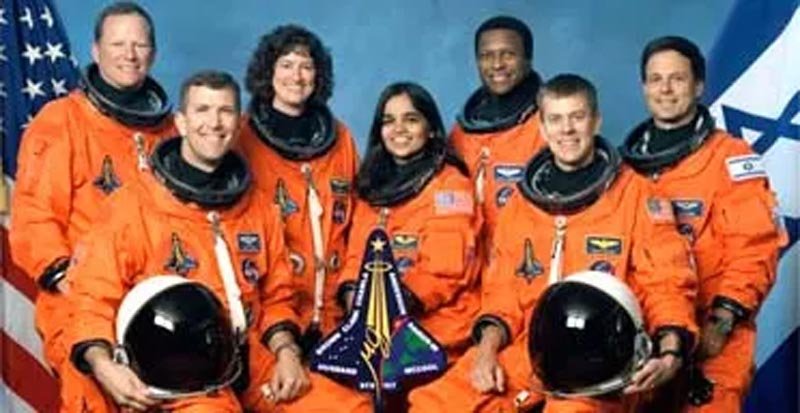
The seven extremely capable scientific minds were to do several experiments in the space for the advancement of the quest of the human race. They were scheduled to do more than eighty experiments in space research. One of the study was to see the changes in human body, proteins and metabolisms in zero-gravity conditions of space. In the same cause the shuttle was carrying a ‘Space Lab Research Double Module’ as a payload. Such experiments were not possible in gravitational and heavy atmospheric conditions of the earth. The group was also to study the changes in humans at harmonal level besides lung functioning and the systems of the nerve control.
The research team was carrying containers with ants, spiders, silk worms, honeybees and fish for the research purpose. The researchers also had to do experiments with fire, crystals and the waves. The team was to monitor through a special camera atmospheric dust particles hung over Israeli Space Agency which was perhaps the lot of the Israeli Payload specialist to practically involve his country and the people just like the first Indian male astronaut Rakesh Sharma experimented on yoga exercises in space years ago.
These space research experiments scheduled to last 16 days were to directly benefit at least 70 earth based scientists as a part of the mission who would be locked to the space activities.
The biggest beneficiery of the S.T.S-107 Research Mission was to be medical science as most of the space experiments were related to that field. All the astronauts were busy in their preparations for the big occasion.
NASA was considerate enough to allow its astronauts to individually invite their near and dear ones, aquaintances and special ones to witness the events of the blast off and the landing of the mission shuttle they were in. It was a very thoughtful move because the space passengers were the people who had very eventful careers involving numerous people over the periods associated with their advancement culminating into that role in that spectacular human endeavour. In their mission all the associates, social, educational, scientific and even the romotely related saw their own participation emotionally. Kalpana Chawla belonging to an emotional society like India could have wished to invite the whole country which was, of course not possible.
She nevertheless invited her close ones from Karnal, Chandigarh and Delhi to the space launch center. She also sent invitations to Professor V.S. Malhotra of P.E.C. Chandigarh and actor-Parliamentarian Sunil Dutt. Her e-mail read—‘By Cloumbia Space Shuttle I am going into the space for 16 days on 16 January, 2003 alongwith other astronauts. I want all my dear ones at Houston when I come back. Sending all the necessary documents.’
Late actor-member of Parliament, Sunil Dutt had family relationships with Chawlas. He also got invitation through e-mail but he could not go due to serious illness. Same was the case with Professor Malhotra who happened to be busy in professional engagements. It greatly pained Kalpana because he had been her guiding teacher during her college education as already revealed. Before taking off in Columbia barely three days before she sent another e-mail dated 13 January, 2003 to her teacher which read—‘I will be leaving from Houston along with my team mates….will always remember you.
Kalpana’
But unfortunately Professor Malhotra still could not make it.
The NASA tradition allowed the astronauts to carry along any 5×2’ banner, slogan, picture or logo related to their near and dear ones or one’s own choice.
Kalpana contacted her Alma Mater, P.E.C. Chandigarh informing that she would like to carry into the space something belonging to it as a memento by her association. The college was requested to provided the item it deemed fit for the occasion.
The reqeust was made through Chandigarh Administrator, Lt. General (Rtd.) J.F. Jacob who was then serving as the Governor of Punjab and Haryana.
After a discussion, the teaching staff of the college (P.E.C. Chandigarh) got Professor D.S. Kapoor to prepare a painting of Kalpana Chawla herself by a computer and sent it to NASA.
The picture delighted Kalpana and she duly installed it into the crew cabin of Columbia.
On her previous voyage scheduled for 11 July, 2002 which was postponed eventually she had requested her school ‘Tagore Bal Niketan’ send some items for the same purpose. The school had sent some items along with a logo which also had been placed in the crew cabin.
Astronauts also were allowed to take along some literature or music to fight the boredom and the monotony of the space journey. Kalpana opted for some music albums of American composers and the sub-continental singers. Among Indo-Pak musicians Kalpana’s favourite was the late Pakistani singer Nusrat Fateh Ali Khan. Needless to say that in all these preparations her husband J.P. proved most helpful. Now Kalpana was all set for the tryst with the space.
Close family members of Kalpana had already arrived at Houston before the blast off. They included her parents, eldest sister, sister-in-law and her children besides others.
On 16 January, 2003 at the appointed hour Mission S.T.S.-107 members boarded Columbia Space Shuttle at Kennedy Space Center. The hatch door was shut. Everything was working fine. There was no hitch or the glitch of any kind.
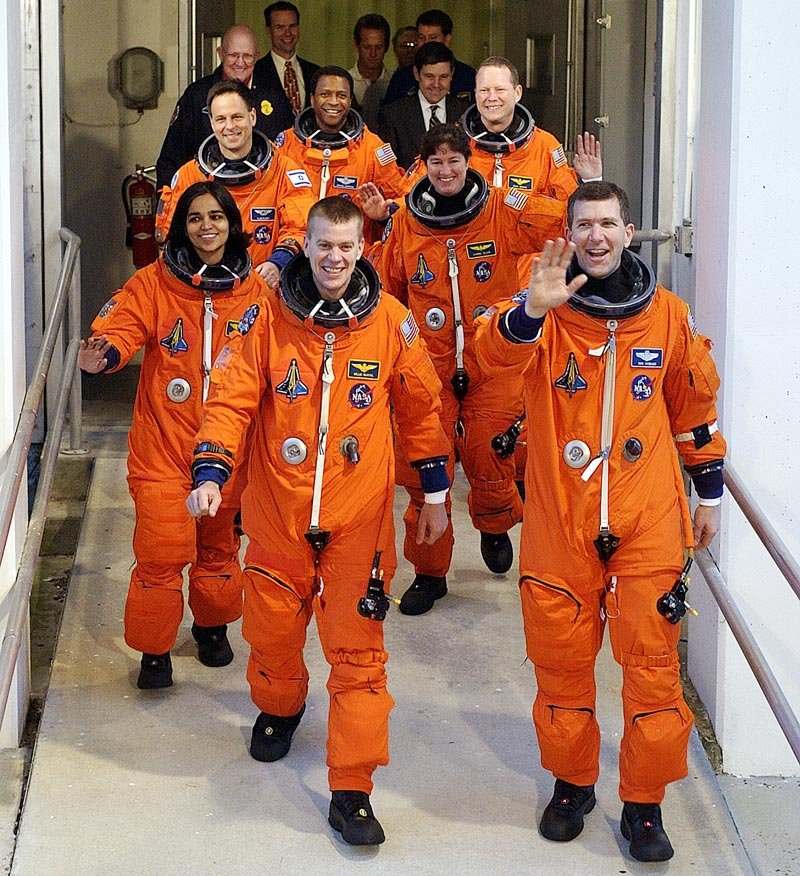
The Countdown had already begun. Only one minute remained for the blast off. Ignition had started. Thick smoke and the sparks could be seen. The astronatuts already strapped to their respective seats shut their helmets and locked them. They could feel the vibrations of the powerful rockets working up the mighty thrust.
Six seconds to lift off—shuttle engine got started. At this stage something went wrong which could not be noticed at that time. Later on detailed analysis were done after the mishap and the repeated viewing of the pictures taken by outer cameras revealed that some metallic piece splintered off from the rocket section and flew down to hit the fuel tank of the shuttle chipping off a part of the insulation tile. It was to prove catastrophic in the end.
At zero count the rockets spewed clouds of gas and streams of fire to power the lift off of the massive space contraption. The astronauts felt a mighty jolt as Mission S.T.S.-107 headed for the space defeating the gravitational pull of the earth. The spectators gave a loud cheer and hand clapping to the successful launch. In a matter of seconds the space craft diminished into a dot and then disappeared leaving behind only a trail of white cloud.
In only a matter of 8 minutes Columbia Space Shuttle had reached the orbital point 178 miles off the earth. Once getting set into orbital path the engines of the shuttle was turned off and all the crew members busied themselves in their own respective research works or duties.
S.T.S.-107 team had been divided into two group code named as ‘Red Group’ and ‘Blue Group’. The ‘Red Group’ consisted of the Commander Rick Husband, Pilot Elan Raymon, Mission Specialists Kalpana Chawla and Laurel B. Clark. The ‘Blue Group’ was made up of David Brown, Pilot William Mackool and Payload Commander Michael Anderson. Red Group was to work from the morning to afternoon and the Blue Group from evening into the night. All had begun their tasks.
On 18th January, the astronauts took part in an interview organised by NASA. Through the interview Rick Husband provided general report on the progress of his researches to the scientists of NASA. One very surprising revelation he made was about mysterious sounds he heard inside the shuttle.
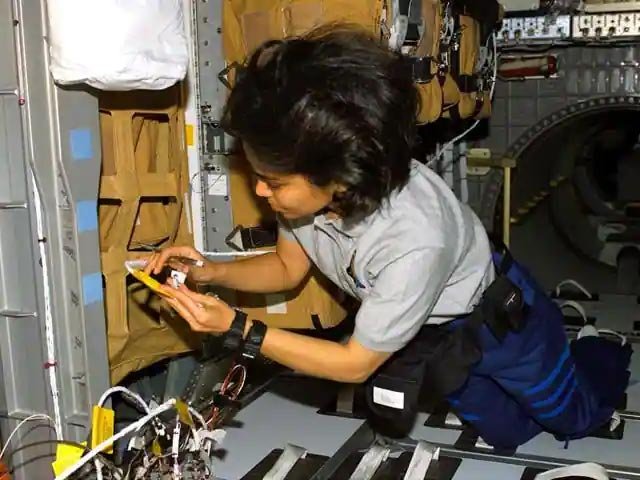
While the astronauts were busy in their research works, other small creatures taken along by the researches into the space were busy in their own life chores. The spiders provided by Melbourne college students were busy weaving their cobwebs—without betraying any oddity in alien situation. The student of a New York school had sent ants who were busy in their natural exercise of moving in two way traffic lines. A Tokyo research institute had given Medaka fish foetuses which were growing up into fish in the space lab aquarium. The silk larvae provided by Beijing school students were progressing normally to cocoon themselves…and even the bees were hovering on the flowers and collecting honey as efficiently as on the earth.
The insects were showing no abnormal behaviour in the zero gravity space conditions. They were going about the life in normal way as if in the laboratory on the earth. The researchers were keeping a close watch on them and noting down every activity.
Israeli pilot Elan Raymon was busy doing his experiments in the study of the brilliance of a flash of lighting. On 21st January he captured some very memorable scenes in his camera.
On 23rd January, Michael Anderson and Kalpana Chawla prepared ‘Flame Boxes’. This faintest form of light can not be sighted with naked eyes. Every flame box contained half a watt of energy which is equivalent to one hundred times lesser amount of one candle light unit. Besides these they carried out several experiments on the light, liquidity and gravity.
On 26th January Tokyo Medaka foetus evolved into a baby fish. Beijing silk larvae duly emerged out of their cocoons as worms.
All the research activities being carried out in the shuttle lab were being videographed and sound recorded by cameras and recorders respectfuly that were set in the shuttle and the lab. Some of the live visual recordings were being relayed to NASA.
During this Columbia Space Shuttle mission, there already were three scientists in the space doing research in International Space Station. They were Americans, Ken Bauber Saux and Don Pettit and a Russian scientist Nikolai Budarin. The three had gone to the space station in Novermber, 2002 under ‘Expedition-6’ mission. They were scheduled to return to earth only in March, 2003.
The Columbia space scientists of S.T.S.-107 mission contacted the space station scientists through long distance call. It was a courtesy call. The scientists exchanged pleasantaries and some minor informations with each other.
On 29th January, the astronauts held a video teleconference facilitated by NASA. Michael Anderson claimed that his research team had made some important discoveries in answer to questions put by the pressmen. He hoped that their research would prove helpful in the advancement of the interests of the mankind.
On 31st January, the space researchers wound up their experiments and the space lab was sealed. It was now time to return to the earth. Re-entry processes into the earth’s atmosphere were initiated.