
1924 was worst communal blood shed year. It was sad for the countrymen but good for the British colonial rulers. They were telling the world that staying of the British in India was a necessity otherwise the country would destroy itself in bloodshed in the absence of British. To drive the advantage home British government announced that it would constitute a commission to review the administrative reforms in India.
The Indians were assured that half the members of the commission would be Indians.
On 8th November, 1927 the Viceroy of India announced that a commission under Lord Simon would be coming to India to prepare report on the Administrative Reforms. It shocked the Indian leaders because all the seven members of the Simon Commission were English gentlemen. There was no Indian on the panel of it. It was a stab in the back.
It had become clear that British government had no intention of giving power to Indians. Obviously the report of the Commission would nothing but an eye wash to show to the world that Indians were merely mobs of barbarians already busy in fighting and killing one another, unfit to rule themselves.
The Congress gave a call to the countrymen to boycott the commission. The people were incensed. Protests rocked the country. Lala Lajpat Rai now had two things on his agenda, to go to people to propagate Nehru Report and prepare public opinion against Simon Commission.
‘Simon Commission’ landed in India at Bombay on 3rd February, 1928. It was greeted with black flags and ‘Simon Go Back’ slogans.
Main political groups boycotted the meetings of the commission. Only a minor groups, mostly from backward classes decided to cooperate with the commission inspite of advice against it by the national leaders. They had their own reasons for doing so. One of the prominent leaders to cooperate with the Simon Commission was Dr. Bheemrao Ambedkar who represented a Dalit organisation. He thought that down trodden classes could not hope for any justice from the Indian leaders or societies. They had suffered centuries of upper class repression and gross injustice. In comparison the British were supposed to be more benevolent to them. British too liked to appear so because it helped them show India in poor light. And it was a fact that Indian leaders could offer little concrete to the leaders of the down trodden sections like Dr. Ambedkar for the reason that the orthodox mindset of the upper castes was almost impossible to change.
Lala Lajpat Rai himself knew how difficult it was as he had himself worked for Harijan education and upliftment in Jullundar area. The leaders understood deep down in their hearts the compulsions of Dr. Ambedkar. Lala Lajpat Rai had met Dr. Ambedkar in New York when he was there and Ambedkar was studying in Columbia University. The Indians who had trapped themselves in communal riots since 1924 suddenly woke up to the treacherous game of Simon being sprung upon them. They forgot their differences and rose as one man to face it.
The day of the arrival of Commission members in Bombay was observed as strike day all over the country. The protest demonstration was so fierce in Bombay the Mr. Simon and his fellow members were taken aback. The administration felt outraged. After Bombay, Delhi greeted the commission with black flags. In Madras police resorted to firing. Three demonstrators were killed. Fierce clashes took place in Calcutta.
In October, the commission was to arrive in Lahore, the heart of Punjab. Political outfits and other organisations were geared up to give a black reception to the commission.
Meanwhile, the revolutionaries had organised themselves under the banner of ‘Hindustan Socialist Republican Army’ which was pronouncedly a militant outfit. It had declared its aim to be to drive British out of India through armed battle. Chandra Shekhar Azad and Sardar Bhagat Singh were its leading stars. The organisation’s aims were great but it faced severe financial restraints. No one was ready to fund it for fear of being implicated in cases of violence.
Bhagat Singh had mooted a plan to express public protest by throwing bomb on ‘Simon Commission’ team. The plan was accepted by the organisation’s central committee. But the problem was money. So far the organisation was working on the sum of Rs. 1800 one of its members had run away with from a Gorakhpur post office where he was employed.
So, the organisation directed Bhagat Singh to organise a big protest march against Simon Commission in Lahore in cooperation with the political parties mainly the Congress whose leader Lala Lajpat Rai was already engaged in arousing public sentiments against Simon Commission.
Bhagat Singh was organising the demonstration, under the banner of his ‘Young India Forum’, a kind of political front for ‘HSRA’. Its dedicated members worked hard to make it a big show. It was decided that Lala Lajpat Rai, the most popular and famous leader be persuaded to lead the demonstration to make the protest as the manifestation of public anger. Lala Lajpat Rai readily agreed to it. He held the revolutionaries in high esteem. Infact, that was the period when revolutionaries had become a very potent force. Most of the prominent Congress leaders had also developed a socialist bend of mind. That included Jawahar Lal Nehru.
The police was equally determined to save Mr. Simon and his party from the humiliation.
On 30th October, Simon Commission reached Lahore railway station. The people were pouring out on roads to express their anger against British Simon trick. The members of Young India Forum had stationed themselves at the sides of the roads the Simon party had to pass through.
Meanwhile, a mammoth crowd of black flag waving, banner wielding and anti-Simon slogan shouting protesters had marched from Mori Gate to the railway station led by Lala Lajpat Rai who was surrounded by Bhagat Singh and his volunteers for protection. To save Lalaji from heat a volunteer was holding umbrella over him.
The crowd was thick. Police superintendent Scott had reached the railway station accompanied by an army of police officers to escort Simon and his party. He surveyed the field and realised that unless Lajpat Rai and his band of young followers were moved back the commission members couldn’t be saved from hackling. He asked his deputy Sanders to clear the way for Simon party and if necessary order lathi charge. Sanders moved ahead and ordered lathi charge. In the face of brutal lathi blows the people staggered, some fell back, others moved side ways and some acted in panic. It is one thing to come together in emotionally charged state but entirely different to hold ground under enemy onslaught. Some way opened but not enough to let Simon party through. Sanders realised that Lajpat Rai and his young group had to be removed from there to open safe passage. Lala Lajpat Rai and the young volunteers were holding ground. S.P. Sanders consulted his senior S.S.P. Scott.
S.P. Sanders ordered Lajpat Rai and his young band to move back. He asked the sepoys to push them back. But it was impossible. Behind Lajpat Rai and the young volunteers there was solid human wall. There was no space to move back and the youngmen were not willing. It infuriated the policeman Sanders. He moved ahead wielding his police baton. The police started the lathi charge. The young volunteered shielded Lalaji.
Inspite of lathi charge the human wall was not breaking up. S.P. Sanders came forward raining blows with his large baton. One of his blows came down through the umbrella to land on Lala Lajpat Rai’s shoulder hurting him. He staggered and bent down. The youngmen were ready to hold on and stand ground.
A few more blows hit the youngmen and Lalaji. Lala Lajpat Rai ordered the demonstrators, “In protest against the barbaric act of the police this demonstration is being dismissed.”
The demoralised youngmen had to obey and rally was postponed.
The news of this police act shocked the countrymen. The statements condemning the police poured out all over the country and abroad.
In the evening Congress held a protest rally against Simon Commission outside Mori Gate grounds in Lahore. The people had gathered in a massive numbers. Lala Lajpat Rai also spoke. D.S.P. Neil was there besides other policemen.
Lalaji thundered, “The government that treats unarmed people in such inhuman way can not be called a civilised government the attack on me by its police will destroy this government…”
He looked towards the sepoys and their English officers, particularly at the D.S.P. Neil and repeated words, “I declare that the blows struck at me will be the last nails in the coffin of the British rule in India.”
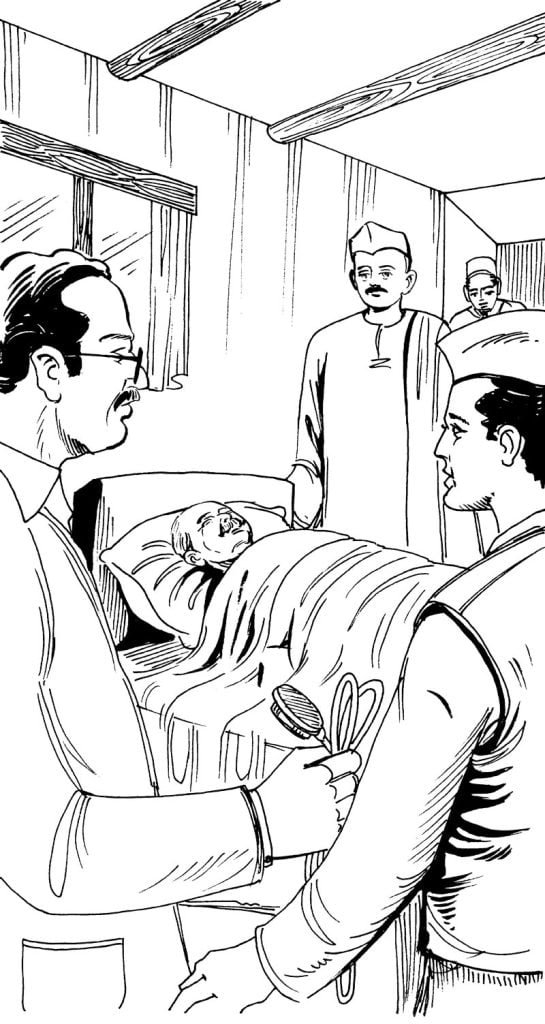
Lalaji looked to be in pain. The doctors examined him and found that the bruises were superficial but the internal damage was considerable. His pride was hurt and he felt humiliated. Condemnation of the police act continued to pour in.
The government again played the usual fraud of probe by a committee and whitewash its misdeed. The people never accepted it.
Meanwhile, Lala Lajpat Rai’s health was taking a turn for the worst. Inspite of deteriorating health he came to Delhi on 3rd November, 1928. But he had to be taken back to Lahore as his condition aggravated. The doctors attended to him but their efforts failed to save Lalaji.
On 17th November, 1928 Lala Lajpat Rai breathed his last.
His death plunged the country in grief. Deep down every Indian prayed for the annihilation of the barbaric British colonial rule. There was a spate of condolence meetings all over the country. Condolence messages poured in.
Gandhiji said—“As long as the sun shines in the sky no one can take away Lajpat Rai from us.”
Motilal Nehru spoke—‘At this critical hour of our struggle, Lajpat Rai’s untimely death has deprived me of the cooperation of a great comrade and the services of the country’s selfless patriot.”
Mohammad Ali Jinnah said—“He was a great one in the political world of India. He was true and honest man. His habit was to take every one along.”
Subhash Bose said—‘The death of Lajpat Rai is an end of a leading figure of Indian Nationalism.’
His American friend Sunder Land wrote—‘Lajpat Rai was a great man. He would have been great had he been born even in any other country.
Funeral procession of Lala Lajpat Rai was attended by one and half lac people. His close associates were seen weeping. Sobbing faces were countless. All the Hindus and Muslims mourned Lalaji’s death.