
As the Vice-President of India Dr. Radhakrishnan travelled to a number of countries playing the double role of a philosopher and political ambassador of India. In the first capacity he preached the wisdom of ancient Indian wisdom and its need for the world peace and co-existence. As ambassador he worked for the country’s friendship with all the countries based on mutual respect and co-operation.
On his US tour he spoke in the American Senate at Capitol building on 17 November, 1954. He said—
‘I feel greatly honoured at being given the opportunity to speak before the members of this august house. As your Vice President has just mentioned we have adopted several good features from your constitution. One of them is that in our system too Vice-President serves as the chairman of Rajya Sabha, the upper house of the parliament which is equivalent to your Senate. There are many other aspects we have borrowed from you. They include constitutional provisions regarding justice, freedom, equality and brotherhood. They echo the words of Jafferson contained in your ‘Declaration of Independence’, I quote—‘God had made all people equal and has given them some rights which can not be withdrawn. Some of these rights is the right to live, right to freedom and the right of prosper.
These words were not meant for any propaganda but they sprang from the depths of conviction. And these words have proved inspiration for tens of millions of people in and outside America.
We, Indians got freedom on 15 August, 1947. The sympathy and moral support we got from your government and people during our independence struggle are remembered by us with solemn gratitude.
When the power was transferred to us most of the people believed that we won’t be able to keep our unity intact and our administrative system would disintegrate, the anarchy would prevail, no one would abide by the rule of law, the life and property would have no security. But those doubts stand dispelled. We are one united nation and the integration is getting stronger. The administration is working as usual. The law and order is normal. There is no area in the country where the government’s writ does not run. The foreign tourists come to India and they face no problem of their own safety or that of their property anywhere in our land.
But these doubts are the symbolic of the magnitude of the tasks we have to execute. Our human population is 360 million out of which 170 million are registered voters, out of which 106 million exercised their franchise in the last general elections. That should give you the idea of the gigantic proportions of the challenges we meet. We know that those who are interested in this democratic experiment they will lend us their support, goodwill and sympathy in developing a great democratic institution.
We know that the political independence is not an end in itself. It is merely the means to achieve social equality and economic justice. As your great Jefferson said—‘Mankind was not born with a saddle on its back and neither were there any God’s favourites in the jockey dress born with divine right to ride.’
The aim of the government is give to its people social equality and financial opportunities. We are trying to bring socio-economic revolution in our country. No need to fear the word revolution. It does not mean regimentation and bloodshed. For us it only means great changes that are badly required. We are not only interested in achieving our goals but also in how we do it. For us objective and means both are essential. We gained freedom through peaceful and constitutional means, unionised the country and now we are trying to raise our economic standards.
The democratic process may be slow and complicated but we hope that they will be effective and speedy. Even if we fail to achieve our goals through peaceful means instead of using force and persuasion, we hope that failure would be temporary because the roots of goodness go deep into the nature. Mercy and love are as contagious as hatred and cruelty.
Our ancient traditions and our recent history prove that peaceful means yield permanent results. We don’t want to solve our problems by sword or at gunpoint. We shall use patience. We feel that in this atomic age losing the sense of patience and righteousness is plain stupidity, if not dangerous.
No society is immobile and no law is unchangeable and no constitution is permanent. Allowing time and patience human nature and the social systems reflecting it can be subjected to basic changes.
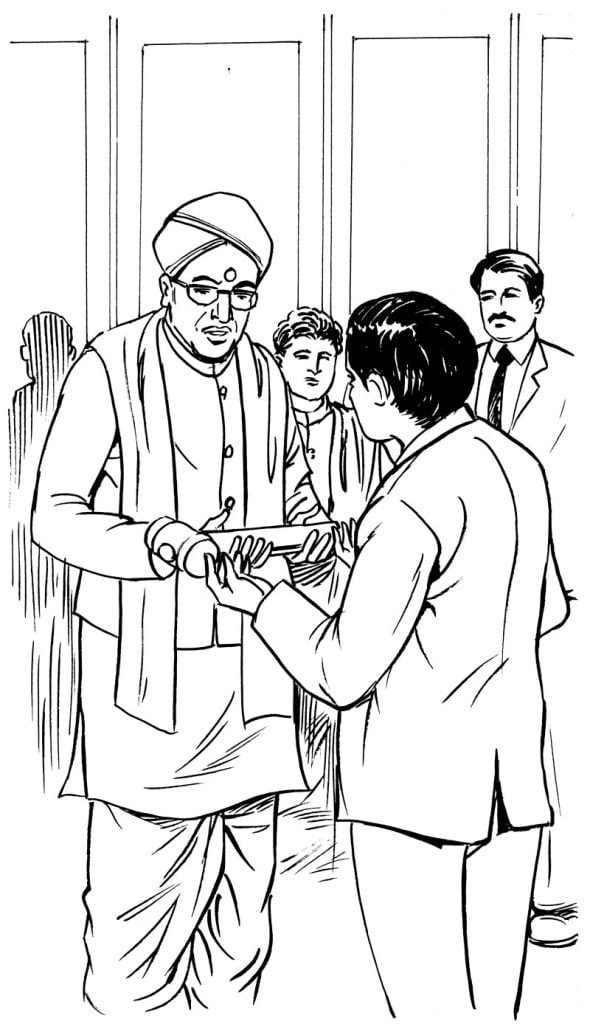
When my government asked me to present a hammer to your Vice President I looked into some books to see the definition of it. ‘Freemanson’s Monitor’ defines it as—
‘Ordinary hammer is a tool of mason. He uses it to round the rough edges of stones to make them suitable for building purposes.
But we know it as an inspiration to round the rough edges of our mind and the conscience. Human nature is like a stone with rough edges. To re-design the human nature it is being used, for the noble purpose of rounding off good, skilled and disciplined people.
On behalf of India’s fledgling democracy and its Upper House of Parliament, with joy and pride, I present you Mr. Vice President, this hammer, hoping that the law makers of this Senate and President will consider the international issues with peace and calmness, sparing the emotions and prejudices, for the great objective of the welfare of the mankind and great American people.’
Thus as Vice President he raised his voice for world peace, cooperation and co-existence. In 1961, then incumbent President Dr. Rajendra Prasad fell ill and during that period Dr. Radhakrishnan discharged the duties of the President with grace and great efficiency.
On 13 May, 1962 Dr. Rajendra Prasad resigned from the post of the President on health grounds. On the same day, Dr. Radhakrishnan, the great philosopher took oath as the President of India amid presentation of 31 gun salute.
The world showered praises on India for according recognition to its scholar son which no other nation had done hitherto. The famour philosopher Lord Burtrend Russel wrote in his congratulatory message—‘The philosophy has been honoured. The world’s peace loving and rational society greets this selection.”
He served the nation as Vice President for 10 years before the elevation to the highest post.
He had not been president for long when China treacherously invaded the northern frontiers of India. The country was shocked and angered. In that dark hour of the independent India, Dr. Radhakrishnan kept up the morale of the country through his philosophical thoughts and conveyed to the world his anguish through his sovereign world-philosophic theories. He toured several countries and spoke to world leaders and the people revealing the dastardliness of the act of the aggressor.
He won many supporters for India.
In 1963 he toured Afghanistan, Iran, England and the USA. While in USA he was welcomed to White House where he was received ceremoniously by President, J.F. Kennedy who said—‘India is the biggest democracy. India and United States of America are bound by the sacred thread of their common resolve to uphold national independence and individual liberty.’
Pennsylvania University conferred on Dr. Radhakrishnan the degree of ‘Doctor of Laws’. On that occasion he said—‘The light within us is the only thing that keeps our hopes alive that we can try to create a better and the happier world. This light has shown us the path ahead. It assures us that it is possible for us to bring about a new changed world. My belief is not based on baseless optimism, nor is it on deep pessimism but on realities.’
On 12 June, 1963 Dr. Radhakrishnan reached Britain where he was accorded a grand welcome reception and felicitated.
On 11 September, 1964 Dr. Radhakrishnan landed in Moscow where he had started his diplomatic innings.
In reply to the welcome speech he said, ‘Coming to Moscow again gives me a great joy. Whenever I come to Russia I find something changed, although our friendship is brief yet it is stable and permanent. We want our Indo-Russia friendship to keep growing. It is not only fruitful for our two countries but it is also helpful in reducing the international tensions and in eradicating war from the social life.’
In May, 1967 Dr. Radhakrishnan completed his term as the President. When he took leave of the Rashtrapati Bhavan, all the political leaders, members of both the houses of the parliament and other dignitaries assembled to see him off. His impartial and graceful conduct had endeared him to everyone and commanded respect of all.
After retirement, he left for Madras to live there with his family. Now he was fully free to devote his entire time to his studies and philosophical contemplations. But he appeared to feel lonely and a forlorn figure although he had innumerous friends and admirers all over the world.
In 1973, Dr. Radhakrishnan suffered brain stroke. He lost his power of speech. The treatment continued but it made little difference.
In 1975, he was awarded ‘Tempton Prize for Progressive Religion’. But unfortunately he was in such a deteriorated state of health (mind) that he even could not understand its importance.
The prize money had to be sent back to Oxford University.
His end was approaching fast.
On 17 April, 1975 the thinker, philosopher and political ambassador of India bid good bye to the moral world to go to his heavenly abode whereas according
to his own theory, his soul would continue to feel human kind’s pain and pray for the wisdom to prevail on earth.
Every year, the 5th September would remind the nation of this great son of India.