
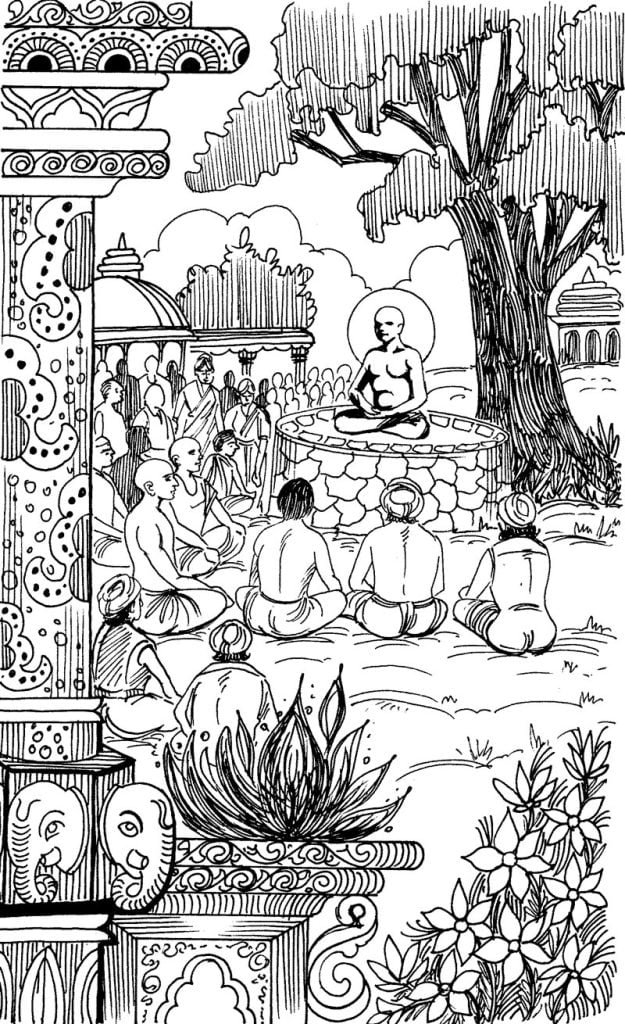
Now Bhagwan Mahavir’s aim was to spread the spiritual awareness among the people to raise their moral values. For that propose in mind he set up Sangha (Union body). Its aim was to eradicate the social evils through the change of heart and to bring harmony, peace and brotherhood in the society.
He divided Sangha into seven following units :
(1) Acharya (2) Upadhyaya (3) Sthavir (4) Pravartak (5) Gunia (6) Gundhar and (7) Gunavedchchhak.
Bhagwan Mahavir’s theory was based on the values of freedom, relativity and non-violence. No muni or sangha could force his wishes on others. Barring some exceptions even Acharya refrained from using coercion or forces.
If one muni wanted something done by other muni he was required to plead, “Please do this…for me if you kindly wish.”
When one muni wished to offer his voluntary service to other he would pray, ‘I wish to serve you of my own accord. Be kind enough to accept my services’.
Bhagwan Mahavir preach equality of all human beings. He didn’t believe in caste or class differences. He gave the society a new vision for harmonious and peaceful living. He used to say that if one person made up his mind and channelled all his efforts in achieving something nothing was impossible.
He advised people to consider the property of the state as their own property. So, it must not be harmed in any situation. Even if the rulers were tyrannical public property should not be targetted in retaliation. The rulers come and go but the state and the people stay.
Bhagwan Mahavir preached that a man must not attach much importance to money, wealth or power. The weak must not be tormented or taken advantage of. One must not force his views on others.
He asked people to give due respect to women. He was against trading of women as slaves and voiced his protest against it. For him buying or selling of women were worst crimes.
He set up Women Sanghas to deal the weaker sex justice. The woman were formally initiated as nuns of the sanghas. All kinds of women joined sanghas. There were beggaresses, princesses, widows, maid servants, abandoned, divorcees and prostitutes. After initiation the all become respected members of the sangha. Even the society was forced to give them their due respect.
In his sangha there were 14,000 monks and 36,000 nuns besides 1,59,000 male and 3,18,000 female members in the general category called Shravaks-Shravikas. The head of the male section was ‘Indrabhooti’ and female wing was headed by ex-princess, ‘Chandanbala’.
There were strict rules and regulations for monk (Bhikshus) and nuns (Bhikshunis). Their daily regime was :
- Self study in the first quarter.
- Meditation in second quarter.
- Meals in the third quarter.
- Self study again in fourth quarter.
- Self study in first quarter of night.
- Meditation in second quarter.
- Sleep in the third quarter.
- Wake up and study in the fourth quarter.
There were strict rules in respect of eating for munis as the following :
- Munis won’t eat in the night.
- Eat one meal after midday.
- If any one eats more than one meal he should compensate by missing the next allowed meal.
- No intoxicants will be used.
- No eating more than 32 morsels in one meal.
- No speciality food for anyone is permitted.
- The food must be taken in accordance with Madhukaricharya norm.
Bhagwan Mahavir never cared to keep begging carry bowl. After getting initiated into asceticism he took his first meal in the plate of a family. After eating the question troubled his mind—Who would clean it? It could be a bother for some one in the family. ‘Why should anyone suffer for my eating?’ he asked to himself.
He wanted no one troubled for his sake. So, he started eating from his hand. He would extend his hand to receive the food and ate whatever little his hand could hold.
Bhagwan Mahavir had some other regulations regarding dress for his munis:
- One who has conquered shame shall live without clothes on and without bowl.
- Those who still feel shame can wear one piece of cloth and can keep a bowl.
- Those who find one piece too inadequate can use two pieces.
- Those who have conquered shame but feel the cold can live without cloths during summers only.
- No one shall wear coloured or precious clothes.
- Any cloth especially bought for a muni shall not be used.
The 23rd Tirthankara of Jain faith had prescribed no limits for the faithfuls in respect of voyages. One could stay out on the travels for as long a period as one liked. But Bhagwan Mahavir introduced some parameters : He regulated that a muni could stay at one station for 4 months during rainy season. For the rest of the year one was not to stay at a village for more than one month.