
Every year India celebrates 5th September as the ‘Teacher’s Day’. It happens to be the birthday of the country’s illustrious teacher-educationist son Sarvepally Radhakrisnan to commemorate his contribution and inspiration in putting the nation on the education highway.
Background
S. Radhakrishnan was born on 5th September, 1888 in a small town of Tirutani, situated 200 kms North-West off Chennai (Madras). Sarvepalli V. Ramaswamy was the father of the newborn and the name of mother was Seeta Jha. V. Ramaswamy was a poor Brahmin who served as a minor employee of the Zamindar of the town.
Sarvepalli was the name of the native village of the family. Later, the family migrated to Tirutani town in search of the better opportunities. Ramaswamy added the name of his native village to his own to signify the connection. The town of Tirutani was situated in Arcot district of today’s Tamilnadu.
Radhaswami was the second child of the Sarvepallis. Three more sons and a daughter were born to the couple after him. Thus, Radhakrishnan had four brothers and a sister. It was not easy for the poor family to bring up six children considering the fact that in total they were eight mouths to feed. Ramaswamy’s earning was meagre. In such adverse and helpless conditions how young Radhakrishnan managed to devote himself single mindedly to his education which catapulted him to the highest post of the land is nothing short of a miracle.
He made himself a practical example of the value of the learning which inspired generations of young people to become scientists, intellectuals, spiritualists, engineers, doctors, technologists, writers, journalists, planners, researchers, analysts, astute administrators, negotiators, educated industrialists, business managers, thinkers, debaters, educationists, articulate communicators, public servants, visionaries, social elite, intelligentsia, entrepreneurs, progressive politicians, scholars etc to make India a pool of the knowledge forces, the world can buy or borrow from.
Dr. Radhakrishnan eventually became an embodiment of education and knowledge. He always secured I class at every stage of his education. His passion for education can be fathomed by his convocation speech delivered at Calcutta University when he was 60 years old on 23rd January. 1957.
‘For the first 50 years The East India Company showed no inclination to introduce modern education in India. The reason for it was the attitude of the Governor General, Warren Hastings who was a true admirer of Indian ancient culture and Hindu scriptures that ruled the minds and the lives of the majority of the natives. He infact wanted the revival of the Vedic civilisation. For him the best way to do it was to leave the natives alone to continue to evolve guided by the ancient values. In a way it was a noble gesture. But there were missionaries and rising native social reform’s movements that wanted induction of modern education to fight the social evils, irrational customs and blindfaiths plaguing the native societies. Some even saw the policy of ‘Leave the Indians alone’ as conspiracy to keep the natives condemned to the backwardness and the poverty.
Then, Lord Mecawlay became the chairman of the Public Education Commission who wrote his famous February 1895 report which proposed to introduce modern scientific education in India. Lord William Bentick, the Governor General of India accepted the proposal. It was decided that the available funds for the education be primarily used to support or augment the English medium schools and the colleges. In 1855 Public Education Department was set up and two years later university came into existence.
In the initial years the university controlled the education in the colleges of Bengal, Bihar, Orrisa, Assam, UP, MP, Burma (Myanmar) and Ceylon (Srilanka). Gradually its area of control shrank. In the primary stages the university only conducted the examinations. Later, as a result of the efforts of Late Ashutosh Mukherjee, this university set up post graduate faculties of arts, science, literature and researches.
Over the period this great university has produced great scientists and renowned scholars. In our time out of the nine fellows selected for the Royal Society, five came from this University, namely Jagdish Chandra Basu, Raman Saha, Krishnan, Mahalanobis who taught here. Two Noble laureates Rabindranath Tagore and C.V. Raman were also connected to this University. Several great alumnis of this great university have enlightened the world with their purity of thoughts and sublime knowledge of arts, philosophy, science, literature and scholarly wisdom.
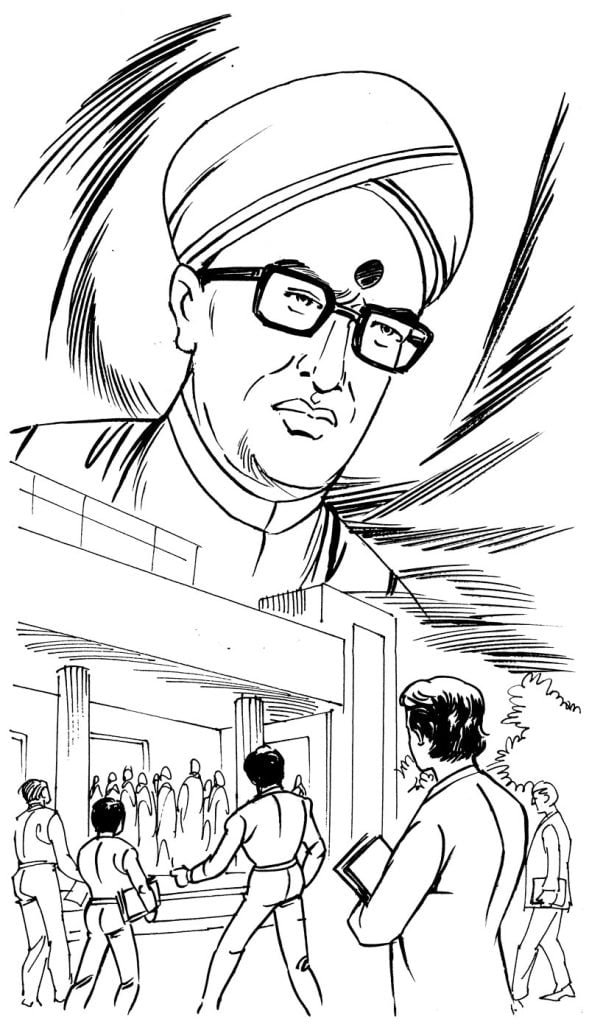
If we look at the world history, it would become clear that the human civilisation is the creation of the ancient sages and the inventive scientists who were capable of inspired thinking, those who go deep into time and space to find the answers to the mysteries which benefit the general mankind and satisfy the hunger of the inquisitive minds. The universities put faith in the indomitable spirit of human soul and they must allow and provide full facilities for studies and research to the scholars and the followers of the literature. They must give full opportunity to all students according to their own standards to take one’s research of facts to the point his wisdom, imagination and honesty of purpose enables him to. No liberty can be true until the freedom of thought is not there. No religious belief or political ideology should put hurdles in the search of the truth.
In this past hundred years, this university has opened up a new world of thoughts for the countrymen. And it has helped in the development of new ideas, in supporting great objectives, giving birth to new movements of life and thoughts and in spreading the political, economic, religious and social freedoms. The cultural renaissance that took place in the last one hundred years was the result of the impact of modern thoughts and criticism on our ancient knowledge. When we impart education to students in the universities we make them curious and critical which naturally leads to their demanding political freedom and democratic environment. Before coming to India Lord Mecawlay had said in the House of Commons—
‘Do we want to keep Indians unlettered ignorants so that they remain our slaves for ever? Or we think that we can educate them without arousing their aspirations? Or do we mean to arouse their aspirations but deny them legal way to reach the logical end? It is also possible that the mind of the Indian people may develop through our system and progress to such extent that they would get out of our control. Possibly we can give our subjects education through our good administration in such a manner as to enable them to gain good administrative qualities. It is also possible that after getting education in European knowledge the natives may demand European institutions and systems. I can’t say if such time would come. But whenever it comes it would be most the glorious day of the British history.
The power may go out of our hands. Our victory may be temporary. But there is a victory that is invincible. There is an empire that is free of any factors that lead to decay. That victory is the victory of knowledge over the ignorance. That empire is of our arts, our ethics, our morality, our literature and our codes.
When we teach our young people the freedom, we tell them that the duty of the rulers is to rule in consultation with the ruled. Then, definitely they will ask for freedom from our rule.’
The first batch graduates of this University was one Bankimchandra Chatterjee who gave in the national theme song ‘Vande Matram’ which was a amalgum of our deep religious sentiment and national objective. It made the patriotism the religion of the youth. Rabindranath Tagore gave us the national anthem ‘Jana gana mana…’ which was sung in this very city on 27 December, 1911 in the Congress Session. The Constituent Assembly approved it as the anthem on 24 January, 1950. It stands for our country as one union and commands us to pool all our spiritual powers for the cultural and emotional integrity of our country.
The modern education naturally resulted in stirring up the unrest and dissatisfaction and then A.O. Hume made up his mind to form a nationalist political party of Indians to serve as a safety value to let off the steam of the native feelings. He spoke to the graduates of this very university on 1st March, 1883 demanding the services of fifty honest and brave volunteers. He said that if fifty dedicated people were available to become the founding members of the proposed party the dream could come true and the rest would be relatively smooth sailing.
A. O. Hume made it clear that if the natives don’t sacrifice their comforts and local advantages then there was no hope for any progress. And that also would mean that the Indian’s didn’t want any better rule than the present one and they didn’t deserve any better. He emphasised upon the eternal truth of the sacrifice and selflessness being the sure means to gain independence and happiness. The first session of Indian National Congress was held in Mumbai under the presidentship of Shri W.C. Bannerji. The Congress was founded with keeping faith in the intentions of the British with the explicit blessings of the Governor General, Lord Curzon. That faith was shattered when the British announced the division of Bengal. The movement triggered off its wake our national conscience. Then passive resistance, swadeshi, boycott of foreign goods, nationalist education, organisation of public opinion and other forms of political protest were adopted which were refined by Gandhi later on.
In December 1906 Calcutta Session of Congress Dadabhai Naoroji declared selfrule to be the objective of all Indians. When the government set aside the division of Bengal the faith of Indians in the British got resurrected and they generously helped England in World War I in the belief that the war was in defence of the democracy. Indian’s hoped that after the war British would grant them ‘Selfrule’ as natural follow up.
The war ended but the native hopes were belied. Then, Indians took recourse to Satyagraha movement. Which gained us total freedom on 15th August, 1947. The power changed hands. This University has produced men of exceptional courage and the spirit of sacrifice who took part in the freedom struggle. Numerous valiant men and women, some alive today and others now martyrs fought against the forces of tyranny.
Today we are celebrating the 61st birth anniversary of Subhash Bose. I have no doubt that the talented people of Bengal, however dejected they may be at this point of time, will continue to carry on the struggle against the evils and show the spirit of sacrifice tolerance until a society based on equality of all does not displace injustice and exploitation.
The political freedom is not only in the interest of India but it will benefit the entire world.
Once Gandhiji had written to Tagore—‘India fallen at the feet of Europe does not hold any hope for the mankind. Independent and erudite India is a message of peace and goodwill for the world. We are eager to make the world safe for civilisation. We believe that today the destructive power of the war has increased manifold. So much so that the peace is the only way of the survival of the mankind. The world is divided in two camps, the atomic weapons of which can create a holocaust if and when the war breaks out. The danger of the mass destruction will ever be there until the rivalry continues.’
The future is in our hands. The pure self-interest inspires us to work for peace and cool down tensions. We must teach the lessons of friendship and civility to the world that seems to have forgotten them. We must create and nurse spiritual powers to regain the last hopes and the forsaken noble values. We should realise that mutual hatred is more harmful than the mutual violence. To make the human mind civilised the spirit of the University which teaches rationalism in these times of madness the jingoist sloganeering of the power blocks with restraint and solid thinking is required to be adopted.
If the world is to be saved it is imperative to remind the people of the different nations the factors common in all. To use her in the political unity, the cultural unity must be nursed and developed. The peace does not merely mean end of the struggles or the silencing of the guns. The absence of the struggles is negative and fragile. The peace really stands for the goodwill for others and compromise with those who are of different faith or nationality. It means that we must learn to respect the feelings of those whose faith and mode of worship is different from ours. It is the goodwill and it is the peace.
In 1831, Raja Rammohan Roy had written to the minister of the foreign affairs of France—It has been accepted by all that the entire mankind is a large family not only by religion but by impartial common sense and scientific researches as well. All the nations and tribes are merely branches of one human race tree. Basically all the erudite persons of the world want to remove all the hurdles in the way of the mankind’s mutual benefits and common welfares to inspire the human unity and its good.
The universality of the man has been the central value of the ancient Indian thought and not the divisiveness. Aryans, Dravidas, Muslims, Christians, Buddhists and Hindus have all got unified in the melting pot of Indian history. We have always been keen to learn from others without becoming their tools. Our culture does not suffer from the false pride of being all self sufficient. We accept all the good values without throwing away our own.
Rabindranath Tagore pioneered the idea of the world cooperation. He travelled to all parts of the world east or west preaching tolerance, coexistence, world unity and goodwill. His belief in the cultural unity of the entire mankind is symbolised by his ‘Vishwa Bharti’.
When Mahatma Gandhi explained the relationship of the national freedom and the international system it reflected his rationality. If, at the same time continued—About the patriotism I think my country should get the independence…if needed the entire country can sacrifice itself to keep the mankind alive. Here there is no place for hatred for the other communities. That is our patriotism. The physical existence is not everything. Spiritual existence is more necessary. Those who worship the Cross know that physical defeat and death can earn moral and spiritual victory.
University is the mightiest arm of the peace. The universities and the societies of the learned ones should impart correct political education to us. They must teach us science, philosophies, astronomy, elementary knowledges, history of the world, correct perspectives and the relativities and insight into truths because they stress on the values higher than the national and the sovereign interests, they believe in the unity of the world and they keep the nationalist forces within the limits of constant balance. They try to evaluate the aliens impartially and are very generous in wisdom. They are cures for the bitterness of being visionaries and for moral weaknesses. The universities of the world are bonded into a clanship.
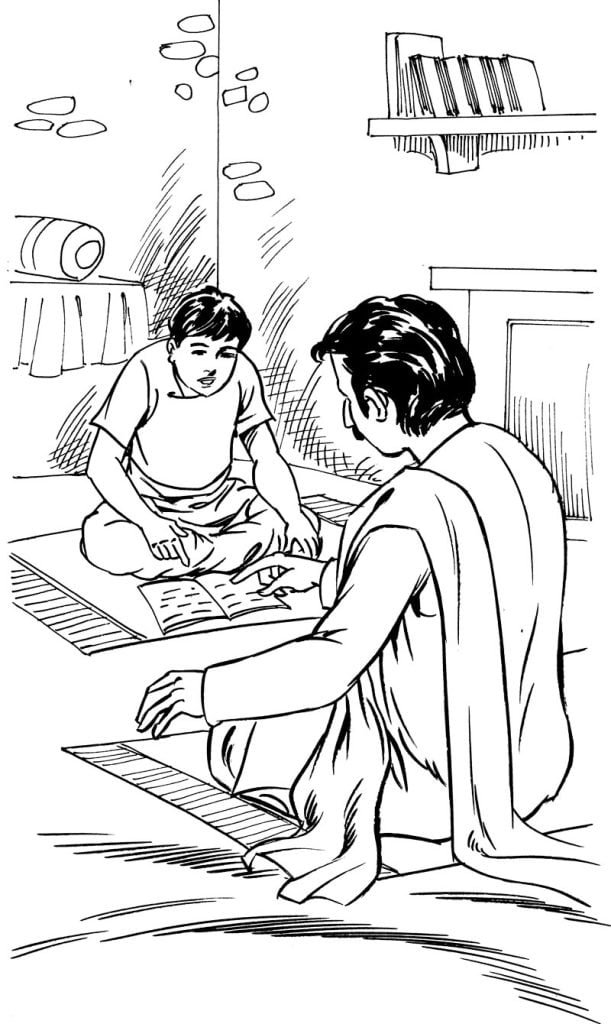
It is said that the weakness of the present generation is its being rootless. It is the true duty of the University to take it back to its roots. We have to do that with compromise and sympathy. If we are to save ourselves from the pressures of the fast modern life, impatience, anxiety and increasing disorders, we must steal some moments of solitude to devote to the spiritual needs. The religion introduces one to the extreme values. Man is not alone in this purposeless world. It is a matter of shame that like rest of the world, here too blind faiths, communalism, slavery, false confidence and arrogance bred.
The religious reformers tried to cleanse the religion of evils, introduce it to God and base it again on the love of all humans. A religion must fulfil the two basic needs of its followers, the first is to reveal the truth of the practical human experience and the second is to carry forward that truth to the following generations. The truth must be capable of understanding the prevailing situation.
The religious scholars of this age have considered the factors of the time and the continuity. We are living in a new world. The universality of the knowledge is new, the shape of the human society is new, the thinking is new and we can’t go back to their old forms.
The religious truth is beyond the scientific accidental revelations. It is based on the human nature’s moral and spiritual facts. Our religious philosophers put faith in the ancient Trilogy and proved that the message contained therein fulfils the criteria of being logical, moral, spiritual, deep and entirety. Brahma is the truth and the yoga is the means and the life. The sages declared that they had seen Power Supreme that was like the sun, divine and beyond the darkness.
The religion is the cause of individual and social ethics and code. Christ attracts us but the Church repels. The social reformers like Raja Rammohan Roy and Ishwarchandra Vidyasagar fought against the social evils like sati custom and caste system. They worked
for the widow-remarriage, monogamy and women education. The society tried to weaken the women by subjecting them to social injustices and the above efforts restored power to them to an extent due to which today the chancellor of this university is a woman.
It is futile to find faults with the old universities. They made best out of the worst situations but there still remains a lot to be done. Our struggle is not yet over. We have to defend ourselves against the anti-wisdom forces, communalism and poverty. We are ourselves responsible for the lack of knowledge, spiritual wisdom, intolerance against social injustice and the spirit to wage a battle against the social evils. We must work with dedication and mobilise our people to make them the defenders of the peace. The rule of barbaric violence won’t last long. The mankind will be redeemed, mutual tolerance will prevail, the truth and love will win. Satyameva Jayate.”