
It is well known that diabetes, also called silent killer, brings with it a host of other diseases also. For example the painful legs, failing eyesight, and flawed memory and such like afflictions invariably make way in a diabetic patient. To date, no permanent cure is found for this malady of high sugar level in blood. So, the patient must live on insulin, the hormonal medicine for the life long. Infact so huge is the number of diabetics worldwide that they have made a global union of their group.

In days bygone, seeds of jambul (Jamun) juice of bitter gourd (Karela), powder of fenugreek (Methi) leaves, and shriphal were preferred grandma-remedies for diabetes in our country. Though out of mainstream medicine for long, it is now well documented that fenugreek to some extent, has the power to control blood sugar levels. This was proved scientifically by the researchers at National Institute of Nutrition, Hyderabad.
The scientists working at the institute discovered that fenugreek is immensely beneficial for patients with excessive blood sugar. This green leafy vegetable can lower down the concentration of sugar in the blood of a diabetic. Experiments conducted on animals have proved that fenugreek not only antidiabetic, it also has a cholesterol lowering effect.
Experiments thereafter were done on human diabetics living on regular dose of insulin injection. Fifteen selected patients were given 100 gm of fenugreek powder daily. After ten days their blood samples were screened, and it was noted that blood glucose and serum cholesterol levels have come down significantly.
In routine conversation, diabetes implies that amount of food sugar in blood goes above threshold limits. This notion, to some extent, is technically valid. But in strictly medical terms, this disease occurs on two major counts. One, slowing down of the conversion of glucose into glycogen. Two, speeding up of formation of glucose from fat globules. Apart from this, amount of glucose in blood depends significantly on how your intestines are working. Researches conducted at N.I.N. Hyderabad have made some more revelations. Like—after successfully testing fenugreek powder on 15 patients mentioned earlier, a fresh batch of 10 diabetics—who were already taking medication, was taken for trial. This batch was given 15 gm. fenugreek per person for a stretch of 15 days. All this while they continued taking their regular medicines also. Results interpreted at the end of fortnight were fairly encouraging.
According to scientists at N.I.N, fenugreek not only lowers blood glucose level, it also helps in lowering cholesterol concentration in human blood. Fenugreek cuts short the metabolic cycle of glucose, and thereby keeps its level in check. Fifty percent of fenugreek powder is fibre which is smooth and non-irritating. Because of this glucose doesn’t get a chance to deposit in the wall of intestine.
Not only this, it is also proved that fenugreek jacks up the number of receptor sites in red blood cells, which thereupon can pick up more number of insulin molecules on them. So how do patients benefit from this piece of information? N.I.N. suggests that diabetics take 2 spoonfuls of fenugreek powder 15 minutes before lunch and dinner, and spoonful before taking their breakfast. This regime ensures that level of glucose plummets by 20 to 25% of the up level. Those who don’t relish bitter taste of this indigenous medicine, may partake of it dressed or fried in vegetables or pulses.
Health of teeth and gums
We know it only too well that not brushing our teeth regularly leads not only to bad breath but also to plaque formations on teeth. This subsequently precipitates smegma on corners of teeth, where, micro organisms multiply aplenty. At times even indulging in onion, garlic and wine may lead to dental decay and foul odour from mouth. Bad breath though could be on account of myriad reasons like pregnancy, diabetes, enteritis, constipation, allergy, malnutrition and concurrent medication.
In such cases there is burning sensation and pus formation in gums, and the enamel of teeth wears off. But bad breath is curable and preventable. All it requires is a bit of caution.
First of all to keep our teeth healthy and shining, we should brush them regularly. Not once, but twice a day, for a minimum of five minutes duration each time.
Always select a toothbrush of premium quality. Same for toothpaste. Tooth brush ought to be such as easily extricates food particles lodged between teeth crevices. Toothpaste should be germicidal. Says Dr. Jitendra Arora, a dentist : ‘‘Strong denture is indispensable for good health. For this, choosing right kind of toothpaste is extremely important.’’ Dr. Arora goes on to add, ‘‘Gargle your mouth daily with mouthwash. Choose such oral detergent which is bactericidal, as well as bacteriostatic.’’
According to Dr. Arora, scaling of teeth needs to be done every six months. This entails deskining of layer that deposit on teeth enamel. This facility can be availed at any dental clinic or hospital.
It is noteworthy that along with cleaning of teeth, massaging of gums is equally important for good denture. Because such exercise increases blood circulation in gums. However, this all needs to be carried out under expert dental supervision.
If you include this cursory caution in your daily habits, you will find your teeth shining, breath fragrant and smile mesmerising. Not only this, regular brushing and meticulous cleaning will not scarce permit any disease process to come near your teeth and gums.
How to brush your teeth
Teeth are generally compared to the shining pearls. Who is not wowed by beauty, glitter, glamour and blitz of this wonder item. No less are teeth in oral cavity, adding to facial grace and good looks. They are inviting and inabriating in one stroke. It hardly needs explaining, how useful teeth are for human health. Teeth are on vanguards of good health and defensive strike. It’s only when teeth are healthy, that health of the remaining body systems ticks. If teeth are diseased, body too feels the drag. Shorn of denture, countenance pales into shadow of its youthful ardour. Dirty teeth are leeway to maladies like arthritis, heart disease, poor eyesight and nervous disorders. Bad breath and swollen gums add to overall damage. If teeth are unfit, man can’t keep a favourable health profile.
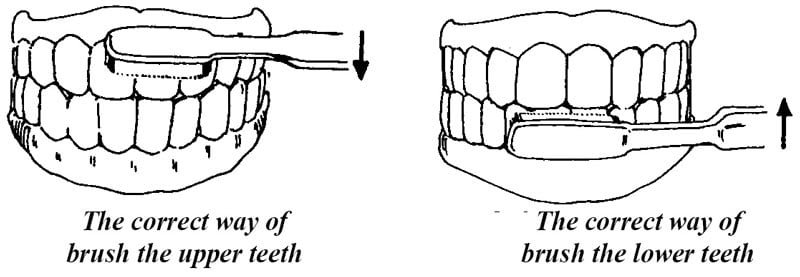
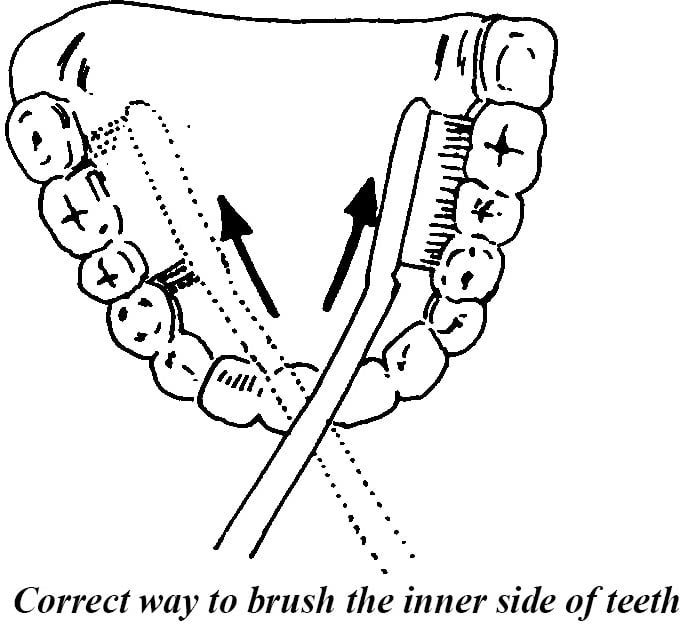
Dental health though, isn’t difficult to achieve. If we brush our teeth regularly, there is no reason why they would shake or fall before a ripe old age. But, surprisingly, 90% of women brush their teeth in brazen manner. Like they use scrub to wash dirty cloths, they scrub their teeth with brush—which is absolutely contraindicated. The right way to brush is this : move bristles on the outside, inside, then up and down strokes, then rub on the cutting surface of teeth, each operation lasting to a count of five moves.
Take care to wash your brush before pinching paste on it. And, when job is over, wash it again and rest it in a clean place or container.
Brush your teeth both in morning as well as at night. After finishing your food, flushing out water with pumping action of cheeks is important. Generally speaking, clinical washing of teeth shouldn’t be necessary till ten year of age. Thereafter, one such medical intervention may be required in every three to four years time.
Indeed onus for keeping your ‘thirtytwo’ intact lies on you alone. So take care. And don’t forget to see your dentist once or twice in a year.
Being vigilant at your own level will help you identify dental trouble well before it’s too late. Avoid things that are excessively hard, crisp, hot or cold as these can damage teeth enamel. Once this protective cover gets damaged, your denture takes exception to hot and cold edibles. Moreover there is no way that lost enamel be layered again on tooth surface.
Parents bowing to their children’s demand for toffees, chocolates and sweatmeat don’t seem to realise that by such pampering they actually end up distributing dental problems amongst tiny tots. Those kids who eat sticky sweets, and go to bed after a sugary meal, loose their teeth while still in their childhood, and subsequently too, dental problems dog them for long.
Dental diseases
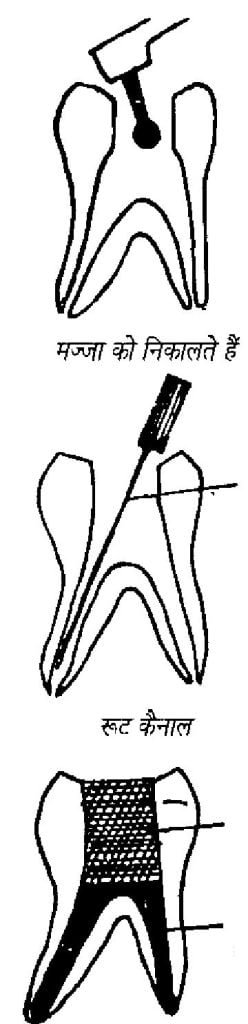
When denied adequate care, your teeth become prone to diseases of myriad kinds. ‘Pyorrhoea’ and ‘Cavities’ are two of their principal afflictions. It’s pyrrhoea when there is oozing of blood from teeth and foul smell emanates from mouth. If cavities form in dental matrix, it is best to get them filled up timely lest these get bigger in size and create further problems. Gums getting swollen and oversized is an indication of gingivitis, and mandates immediate attention. When mouth smells bad and gums are painful, flushing of oral cavity with Amosan or hydrogen paroxide solution in water helps significantly.
Care of teeth is indispensable
Sparkling clean and milky teeth go a long way in enhancing your personality. Whereas a springly smile of shining teeth wins favour, the one with dirty and diseased denture appears intimidating.
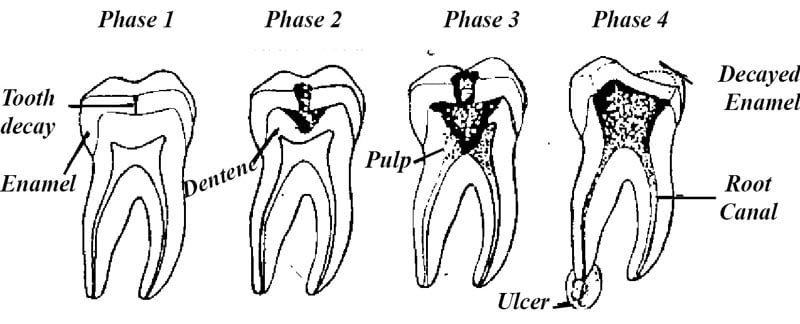
There is a general misconception that infants passess milky-teeth which when fall off, give way to permanent teeth. As such care and cleanlines of teeth should begin only when permanent teeth arrived on scene. But Dr. Rohini Verma, Dentist at Safdarjang Hospital, Delhi says that dental care should begin from infancy, better still, right since the child is conceived in mother’s womb. Teeth formation in pre-natal babies is influenced by the status of mother’s health. If mother takes drugs, alcohol, or smokes cigarette, embryonic development of teeth is adversely effected.
If above substance are taken during pregnancy, ailments of gums and teeth manifest right at the time of the birth of new born. This, obviously, is avoidable if only parents exercise a bit of caution.
Children should be coached to brush their teeth regularly. That too with flexible brush and flouride enriched toothpaste.
As for modus operandi of brushing your mouth, experts opine that it needs to be done at least twice in 24 hours. One swipe of brush should come three teeth surfaces. Move your brush from up to downwards while brushing upper teeth, and from down to upwards while cleaning the lower denture. Avoid brush with hard bristles as they can damage tooth enamel (the white shiny coating on tooth).
As per latest in technical research, if you brush your teeth before going to sleep, you must do this post breakfast the following morning as well. Brushing of teeth at night is important. Along with this generous flushing of oral cavity with mouthfuls of plain water adds to overall cleanliness of teeth and gums.
For health and well being of milk teeth in tiny tots, fast food and sticky items like icecream and cold (aeriated) drinks should be kept away from children. Natural sugars in fruits and vegetables are enamel friendly, hence advisable for children in profuse amounts. It becomes of every parent to ensure welfare of gums and teeth of their juvenile wards. Because if milk teeth fall pretime on account of disease, the set of permanent teeth that follows would be erratic in shape, size and orientation.
Breathing from mouth, thumb sucking and nail biting habit don’t augur well with form and formation of teeth in growing children. Dentists though aver that if structure and erruption of denture is flawed in initial stages of life; it can easily be corrected. Reason being that between 6 to 12 year of age, teeth are still not fully developed. Doubtless, dirt and food particles that accumulate on tooth enamel—are principal triggers of oral cavity afflictions. This trash goes on to become a hide out for pathogenic microorganisms. If not removed by regular brushing, for at last a minute after meals, this dirt cover gets hard and smug, routine methods. Even though toothpaste manufacturers lay claim to tackling this menance, but fact remains that removing this obnoxious layer from tooth surface isn’t easy.
Dental decay and malformations owe their uprise to this languid layer on tooth surface. Thanks to infections that follow suit, fever, bleeding gums, swelling on face and neck and general discomfiture become routine. The only way to avoid these maladies is to brush your teeth daily, rinse them in clean water, and see a dentist every six months or so.
A yet another affliction has come to light recently. It involves frank bleeding from gums during the act of brushing and spouting water from mouth. This not only besmirches sensation of taste, but also fouls the air being exhaled from lungs. The malady is amenable to treatment during the initial stages. The syndrome, to begin with, owes its genesis to food particles which get lodged between inter dental spaces. If not treated early it develops into full fledged pyrrhoea. Pus and blood oozing from overly sensitive gums tell their own story. From here, other systemic disease like diarrhoea may follow as cascading effect.
Adding to the list, secretary glands located in mouth and muscles of gums and cheeks undergo retrogressive changes. Saliva secreted by salivary glands, which is significant cleanser of teeth and oral cavity, gets scanter (may even dry up). This obviously parts paid to self cleansing process that goes on spontaneously in the oral cavity.
If one is not cautious about such developments, it may sometimes prove disastrous for the enire health. Teeth don’t so much fall off on account of age, avers Dr. Verma, as they do on account of lack of care and hygiene. Similarly, even if one doesn’t breath properly, bad breath would automatically menifest. Not only that, faulty breathing may also lead to enteric diseases like acidity.
If breathing in impeded, for whatever reason, it can lead to cold, allergn and other infectious diseases. Even the way we eat has a bearing on efficiency of breathing exercise. It is said that mouthwash should be used to jettison bad odour in breath, but this notion is misleading. The chemicals used in mouthwash are harmful for teeth. Tobacco too, in whichever form taken, has damaging effect.
Dr. Priya Gill of Classic Dental and Orthodontic Centre believes that people per se are lazy in matters of oral care, and most of them and overly dependant on their dentist’s mercy. Because a dentist is approached not for prevention of diseases but for their cure when they have actually struck the blow.
And that’s a fact. Most Indians would see a dentist only and only when medical intervention is called for. Those who can’t afford a dentist’s fee, patronize quacks squatting in lanes, bylanes and public places, albeit only to suffer more agony.
For the moment if you believe your smile is sane and sanguine, then you just can’t do without especial care of your teeth and gums. It seems dental care began in right earnest only when man grew aware of the importance of looking good. Technique of bridge, crown and artifical denture came into vogue with sole objective of prolonging life and utility of teeth in buccal cavity and using artificial aids to their fullest potential, that too by patient himself in privacy of his own home.
Apart from repair jobs like bridge and crown, other facilities like extraction of tooth etc. are also easily avaliable. Now even cosmatic touch is being given to your denture, by way of rubbing a shining substance on to the tooth surface. It’s a new milestone in the field of prosthetic care.
Vitamins and their role
To thrive well, human body requires sugar, protiens, fat, mineral salts, various vitamins and water in a balanced amount. Vitamin E (Tocophenol) is a fat soluble vitamin. Researches in the recent times have discovered many a new facets of this wonder vitamin. Consequently, importance of this vitamin has gone up many folds. If you observe closely commercials on TV and in print media tout Vitamin E as integral constituent in myriad formulations of cosmetics, creams, lipstick, shampoo, soap and such like accessories.
As per the latest informations in medical field, adult’s daily need of Vitamin E is about 10 mg. If taken in a bit of excess, age related reprogressive changes in body skin are arrested or slowed down significantly. Vitamin E works like an antioxidant element, and is assisted in its task by the mineral molybdenum. It is now believed that various diseases in body are a direct outcome of free radicals released in course of myriad biochemical reactions which keep life ticking. Vitamin E helps keeping these free radicals in check. Atherosclerosis, the process of deposition of fat and cholesterol in inner linings of blood vessels; is prevented or substantially delayed by antioxidant action of Vitamin E. Thus one is saved from potential diseases like angina, heart attack, paralysis, high blood pressure and diabetes. Apart from this Vitamin E also lessens illeffects of environmental pollutants and cigarette smoking.
According to experts, Vitamin E helps in prevention of Alzhimeir, the disease characterised by memory loss in old age. A lack of Vitamin E makes body muscles still and paniful. If a patient of these pathologies is given Vitamin E, drastic relief is experienced. It is also noted that those food stuffs which are rich in Vitamin E, have longer shelf life.
Doctors aver that Vitamin E, being immune booster, saves one from contageous diseases. According to investigations carried out at America’s National Institute of Nutrition, a regular intake of Vitamin E capsule post 65 years of age brings down chances of a heart attack by a whopping 41%. Since our food doesn’t have adequate amounts of it in normal course, and importance of Vitamin E is proved beyond doubt; aged subjects are advised to take capsules of this antioxidant on a regular basis. Yet, on the fling side, an excessive intake of Vitamin E (more than 600 units) carried on for years and years, may lead to bouts of bleeding, delayed healing of wounds and even nervous depression.
Doctors believe that if you are in fairly good health, take a balanced diet, and do exercise daily, then an excessive dose of Vitamin E can help. When old age sets in, 100 to 400 unit of Vitamin E can be taken on a daily basis.
A minimum of 15 day’s regime on Vitamin E has no side effects whatsoever. In natural state, this vitamin is found in foods like cereals, animal flesh, butter, milk, and green vegetables. It is rich in yellow of egg and vegetable oils—especially cotton seed and sunflower oil. Its potency goes up upon sprouting of grains and pulses. Vitamin E isn’t destroyed in routine cooking, except when food is deep fried or subjected to very high temperature. Vitamin E adds to fluidity of blood. Because of its thinning and anti-clotting nature, it is not advisable to take Vitamin E prior to surgical operations. Heart patients who are on aspirin regime shouldn’t use Vitamin E except under medical supervision.
As explained, Vitamin E is an antioxidant and it protects body from many diseases. At the same time it checks senile changes thereby making old age a benign phenomenon. In effect, body remains young for long, even past its prime. Not without reason shelf items like creams, soaps, face lotion, shampoo, lipstick and such other cosmetics are now Vitamin E enriched so that hair in bouncy and beautiful, and body skin remains free of age related wrinkles.