
One of the hazards of working life, especially if you have to commute any distance, is the ‘tennis ball’ syndrome: the feeling that you are constantly being batted to and fro, from home to work and back again. Then self-pity starts to build up because you never have any time for yourself: you always seem to be working or commuting or sleeping.
These are terrible feelings to have, easy to indulge and difficult to control; and they sap your vital energy and poison your life. The best way I have found to chase them is to get up early to do something I like doing.
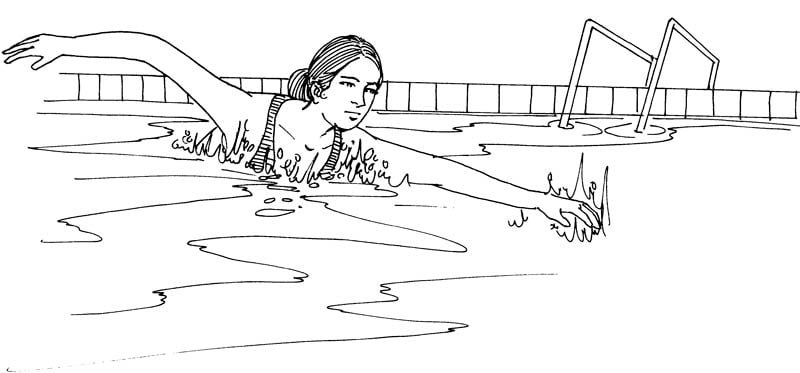
At different times in my life it has been swimming, running, cycling; and for a number of years now it has been yoga practice. The effort of getting up early is thousand times repaid: not only by the physical benefits, but by the very fact of having taken that time to do what I want to do, first-before heading into the day’s commitments and responsibilities.
Even if you are ‘no good in the morning’, you might just find it possible to get up half on hour earlier, and take that time for yourself. It’s your own inviolable space: once you’ve had it, it can’t be taken away from you and your life will feel less of a treadmill.
Start the moment you wake up; in bed. It’s easier to get up and get started if you spend a few minutes stretching even before you get out of bed. Animals do this; you’ll always observe cats and dogs stretching themselves after a sleep before getting to their feet and moving around, unless they have been started or frightened awake. A little stretch in bed will wake up your muscles and get your circulation and breathing going; so that if morning is really a bad time for you, you’ll feel a bit less awful. Then, get up and get on with your chosen activity.
The hours you spend travelling to and from your job are very much a part of your working day, possibly the most arduous part. Commuting can be a nightmare, in which you feel you are fighting in battle against crowds and dismal travelling conditions; and in which everything conspires to irritate and frustrate you. But you can learn to regard it in a different light: as an opportunity for quiet and reflection
Unless you really cannot get to work by public transport, it is better to avoid driving. Driving, however used to it you are, and even if you enjoy it, is hard work. You need to concentrate all the time and contend with harassing traffic conditions. Your journeys are bound to be tiring. If you travel by public transport, it is someone else’s responsibility to get you to your destination, and you can relax and let them get on with it.
It is possible to relax on the train or in the bus: to switch off and turn inward; to replenish your energies instead of squandering them in annoyance.
If your train is cancelled, or the bus queue endless, you can practise standing. Remembering the instructions for establishing the basic standing position, employ your waiting time to centre and calm yourself, strengthen your spine and improve your posture. Then the time won’t be wasted, and you won’t be frustrated.
If, when your transport arrives, you are lucky and get a seat, sit well! Distribute your weight evenly on both buttocks, try not to slump, and avoid crossing your legs, which cuts off your circulation. You can use the time to read, or to think constructively about the day ahead. Or you can simply sit, and breathe.
Here, for example is a very simple breathing practice, which I think you will find refreshing and relaxing. Sit well, your lower back firmly up against the back of your seat, your spine straight and long, your feet flat on the floor and hip width apart, your hands relaxed in your lap (or on top of your handbag or briefcase, which will need guarding).
Your hands can be gently clasped, or folded; or you can hold the thumb of one hand lightly in the other hand. Or you can place both hands palms down on the tops of your thighs. Do whichever feels most comfortable for you.
First, just listen to all the sounds around you. Don’t try to ignore them or shut them out; be aware of as many sounds as possible, both inside and outside your vehicle.
Then, focus on just one sound, letting all the others recede.
Finally, let all the sounds recede and form a background, from which you yourself are detached. Begin to focus your awareness on your breath, and watch each in breath and each out breath.
When it feels natural to do so, gently close your eyes, first blinking slowly once or twice. Soften your gaze behind your closed eyelids.
Observe the temperature of the breath in your nostrils.
Observe the passage of the breath as it moves up and down the nostrils. Observe the texture of the breath.
Make no effort to control or regulate your breath; just let it be and observe it as it is. After a few minutes you will probably notice that it becomes calmer, slower and shallower.
Allow each out breath to take as long as it needs. Don’t prolong it, but also don’t force it or hurry it. Just let it flow out. At the end of each out breath, leave a little space before the next in breath. You will breathe in when you need to, so just wait for that to happen. In the little space between, just sit quietly.
As each breath flows out, feel that your facial muscles are softening. Feel that your forehead is widening, that the frown lines are being smoothed away, that your eyelids are growing softer, that your cheeks are growing fuller. Feel that your lips are soft: they should be just lightly closed, and your teeth slightly open. Check your tongue: if you find that it is clamped to the roof of your mouth, release it and let it rest gently behind your lower teeth. Just let it be thick and heavy in your mouth.
Then focus your awareness on your hands and with each out breath feel that they are growing heavier and quieter. Be very aware of your hands, and of the sensations of stillness and heaviness in them.
Don’t attempt to resist the movement of the train or bus. Just allow your body to give to the movement, and to go with it.
Shortly before you reach your destination (or whenever you’ve had enough), gradually begin to deepen your breathing Then stretch your fingers and hands and move your feet. Open your eyes slowly. When you get up, do it mindfully, disturbing yourself as little as possible. Don’t heave yourself out of your seat and rush headlong to the ticket barrier. Move with awareness, keeping the sensations or relaxation and heightened awareness as you continue on your journey.
You may find this practice so relaxing that you fall asleep, particularly on your homeward journey. Be careful not to ride past your stop—and make sure you have collected all your belongings!
When you have to stand, stand well. Plant your feet firmly on the ground, hip width apart or a little more if there is room, and parallel. Squeeze your buttocks together and tuck your pelvis under. Keep your buttocks firm throughout the journey; they will support you and help to keep you upright. Instead of strap hanging, which will pull your spine out of alignment (especially if you are short), practise holding your balance without using your hands. As your vehicle moves and sways, allow your body to go with it, shifting your weight through your feet to adjust your balance. Allow your knees to ‘give’ a little, and keep the backs of them soft. Let your shoulders, neck, jaw and tongue be soft.
Possibly you really do have to drive to work. In that case, you will be able to minimize the stresses and strains of your journey to a considerable degree, mainly by observing the principles of good sitting. Make sure that the base of your spine is right up against the back of your seat, so that your back isn’t rounded, or your chest collapsed and your abdomen squashed. Make a point of lengthening upwards, consciously lifting your ribcage and drawing your shoulders back and down. Then you will be able to breathe well, and you’ll be giving your internal organs room to function. Make sure that your feet are at the right distance from the pedals, and your body at the right distance from the steering wheel, so that you don’t build unnecessary tension in your legs and arms. Hold the steering wheel lightly; gripping it will create tension in your hands, arms, back, neck and jaw. Try not to clench your teeth or drive with your chin.
When you are stopped at a traffic light, or stuck in traffic, accept that there is nothing you can do to speed things up. Regard that time as time for yourself, an unexpected gift; use it to switch off and let go. Apply the handbrake and shift into neutral; pull your shoulders down, rest your hands in your lap, and take a few deep breaths. Even a few seconds spent like this will relax you a little—and it will be a much more fruitful use of the time than fuming, ranting, clutching the wheel and reviving the engine; which won’t get you to work faster but will ensure that you are a mass of tension and frayed nerves by the time you do get there.
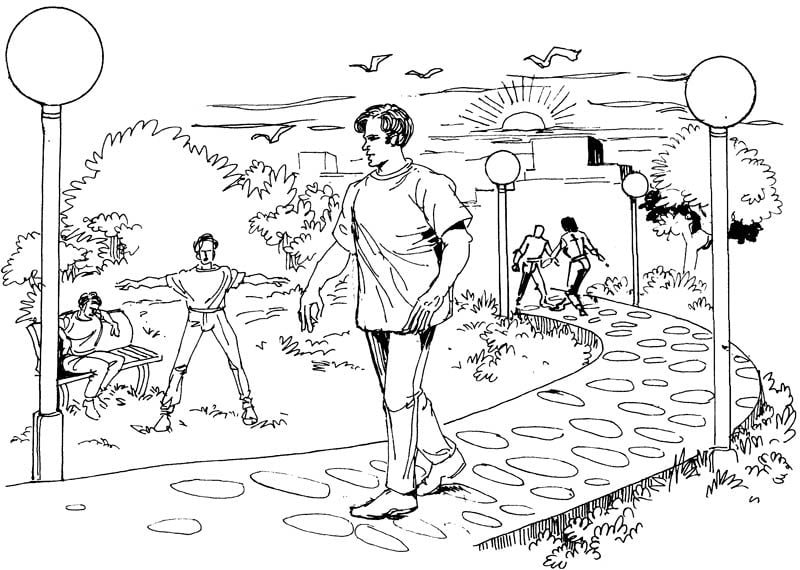
I’ve assumed up to now that you have to use transport of one sort or another to get to work, but you are lucky if that isn’t the case. Walking is one of the best forms of exercise and if you can walk all or part of the way to and from work, you’ll get fresh air (or at least air) as well as movement, Perhaps, even if you do use public transport, you could get on a few stops further down the line, or get off a few stops earlier.
When you walk, try lengthening your normal stride by just one inch. This is a remarkably effective way to maintain and increase your hip mobility. If you walk a lot, try to avoid carrying heavy briefcases, handbags for shopping, which not only unbalance you but also strain your wrists, elbows and shoulders, A rucksack will save those joints, guard your balance, and make for a more enjoyable walk by leaving your arms free to swing. Shoulderbags, incidentally, are not a very good idea. They nearly always force you to lift the shoulder they ride on.
Consider cycling, if the traffic through which you would have to ride is not too horrendous. I used to do it regularly, but stopped after a minor accident; I don’t like recommending it, especially now that the roads of most inner cities are deteriorating at such a rate. The prospect of hurtling into one of London’s potholes scares me even more than the traffic. But if you are a good cyclist, and you enjoy it, your journeys will give you plenty of excellent exercise.
Your lunchtime gives you an opportunity to get out of the office and stretch yourself. Perhaps there is a nearby park you could walk in, or a swimming pool, or a leisure centre with lunchtime exercise classes—possibly even yoga classes. Doing something of this sort will make a wonderful space in your day, particularly if your work involves always being at others back and call. There is the danger, in this situation, that you’ll begin to feel you unhappy and affect your work and your relations with others. Doing something for yourself, something you like doing, is the best antidote; again, you’ve chosen to make a space for yourself, and no-one can take it away from you.
More and more firms are becoming aware of the problems of stress in the workplace and attempting to find ways of helping their employees with these problems. Why not suggest to your personnel department that they make a room available for exercise and relaxation and even arrange and subsidize classes?
If you can apply even a few of the suggestions in this and the previous chapters, I think you will find that you reach the end of your day, in the office with energy to spare for the rest of your life: the vital part that isn’t work. You’ll know how you want to use those precious hours, so I’ll skip now to the very end of the day.
A few slow stretching exercises before you go to bed will calm you and help you to relax. I also find it helpful actually to practise conscious relaxation of muscles for the first ten minutes or so in bed, before going to sleep. When I take the time to do this, my muscles really let go and I sleep better.
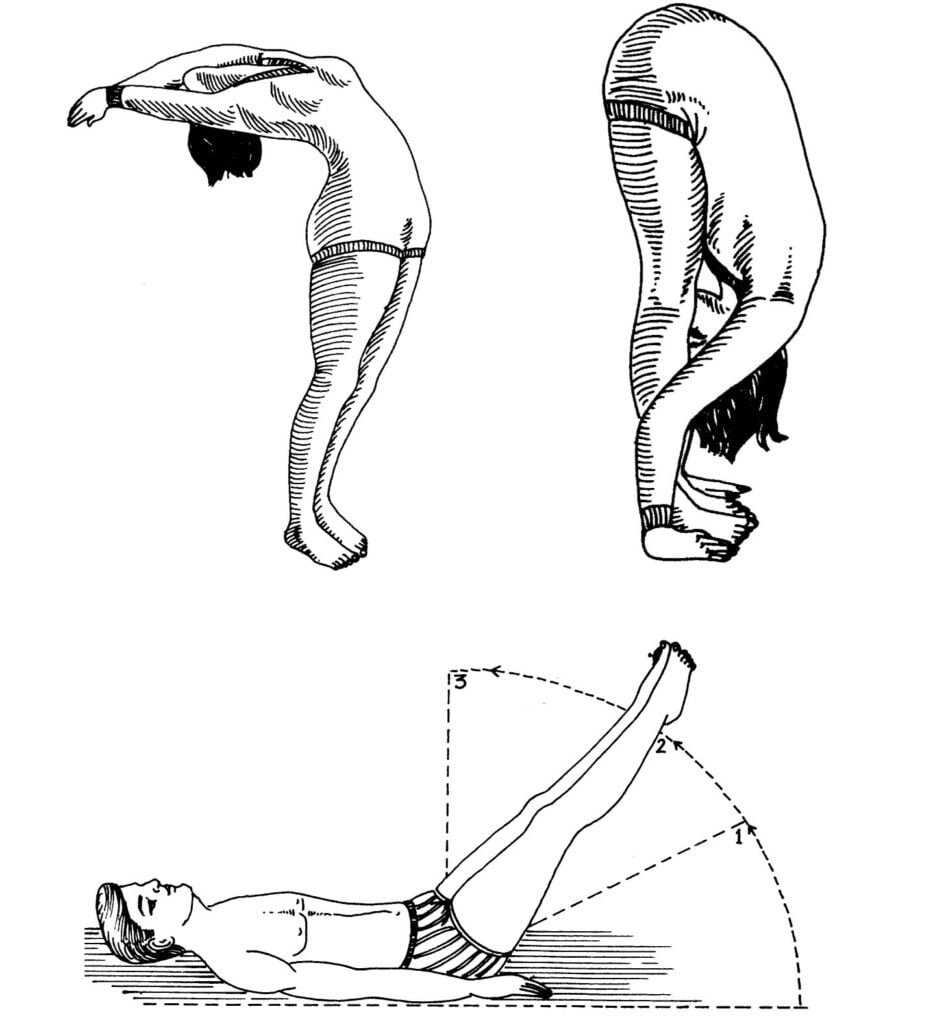
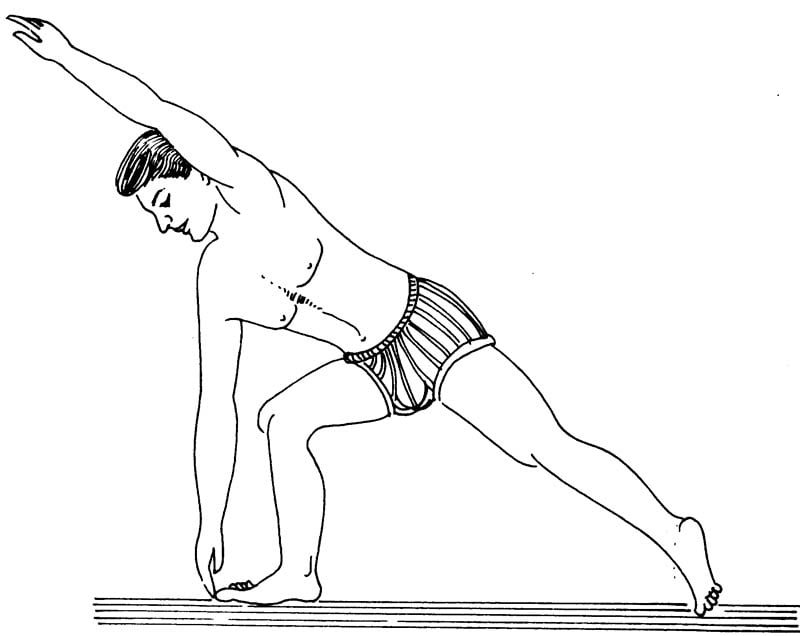
If you’d like to try this, first of all lie down carefully on your back, without ‘plunking’ yourself. Make sure that your whole body is in line. Gently stretch your heels away from you, and stretch your fingers and hands. Draw your shoulders down away from your ears. Rest your hands comfortably on your abdomen or your ribcage and have your elbows far enough out from your body so that your shoulders can let go. Your upper back should feel wide and your chest open.
Become aware of your breath and observe it as it begins to settle and slow down. On each out breath, let go of a little bit of tension; feel it flowing out of your body with the breath.
Mentally go through your body beginning with your toes, feet and legs; continuing with your fingers, hands and arms; your torso, and finally your face; your forehead, your eyelids, your nose, your cheeks, your lips, your teeth, your tongue and your jaw and throat with each outgoing breath, let go of tension in that part of the body. If your tongue is clamped to the roof of your mouth, release it and let it rest on the bottom of your mouth, just behind your lower teeth, feeling thick, wide and heavy.
After ten minutes or so, your muscles will have surrendered a great deal of their tension and will allow you to experience a sounder and more restful night’s sleep. (By that time you may well have fallen asleep anyway!)
The time you spend watching television can be used to practise sitting well in your chair (instead of slouching!). Better still, sit cross legged on the floor to give your hips a passive workout. Place a firm cushion, or some telephone directories under your buttocks to ease the strain on your lower back and to allow your knees to touch the floor and work on lengthening your spine.
Or you can sit (on your sitting bones) with your legs outstretched in front of you and your hands resting comfortably in your lap and stretch your spine. By stretching your heels away from you can also stretch the backs of your legs. If you find this uncomfortable at first, elevate your buttocks to reduce the strain on your back until the muscles are stronger.
Sitting in this position, you can do all the exercises for the toes, ankles and knees’ fingers, wrists and elbows. If you find this a strain on your back, you can lean slightly back from your hips, placing your hands on the floor beside your hips or slightly behind them for support while you do your toes, ankles and knees. But make sure that you keep your spine long and upright: don’t allow it to collapse.
You can extend this exercise by stretching your upper body forwards, moving it from the hips. Don’t tempted to round your back in an effort to ‘go further’, but keep your whole spine in a good straight line and direct your chest forwards rather than downwards. Increase the stretch very gently and very gradually; don’t force it. Remember, It’s not how far you go, but how you go that is important.
You can also sit with your legs wide apart and your heels stretched away. This stretches the adductor muscles of the insides of your thighs, as well as stretching your spine and strengthening your back.
This exercise can be extended in the same way as the previous one, by stretching your upper body forwards— again making sure the movement originates from the hip joints. Place your hands on the floor between your thighs in front of you. Again, increase this stretch gently and gradually.
Finally, here are two exercises to open your hip joints and increase their mobility, which are nice to do in front of the television. These stretch your spine too!
1. Sit on your legs outstretched in front of you, and lengthen your spine. Bend both your knees up and bring your heels as close as possible to your buttocks. Then allow your knees to drop towards the floor and bring the soles of your feet together. Take hold of your ankles, one in each hand and gently press with your elbows on your inner thighs to encourage your knees towards the floor (don’t press so hard that you strain your knees; if you feel pain or discomfort, go easier). Sit with your spine upright and keep lengthening it upwards as you direct your knees towards the floor.
2. Sit like this for as long as you feel comfortable. Then gently release your ankles and carefully lift your knees, placing your hands under their sides for support. Straighten your legs and circle your ankles. Your can extend this exercise by clasping your hands around your toes, but only if this doesn’t cause your back and your chest to collapse. If it does, return to holding your ankles.
When this position feels easy and comfortable, you can extend it further by stretching gently forwards from the hips.
Sit as before with your legs outstretched in front of you and lengthen your spine. Bend your left knee and bring your heel right into your groin, placing the sole of the foot against the inside of your right thigh. Bend your right knee and fold the leg back, bringing the foot close to your right buttock. Rest your hands comfortably on your knees, lengthen your spine and breathe steadily.
Sit like this for as long as you feel comfortable and then carefully straighten out your legs one at a time and change over to the other side.
Straighten your legs. Bend your feet forwards and backwards a few times and circle your ankles.
With these exercises, you can spend half hour to an hour’s practice while watching your favourite programme—after which your body will be stretched and opened up.